The H-1B visa program remains one of the most important pathways for U.S. businesses seeking specialized international talent. Technology companies, healthcare organizations, engineering firms, financial institutions, and other employers depend on skilled professionals to fill positions that require specialized knowledge.
However, the H-1B landscape is changing. In 2026, employers and foreign professionals must pay closer attention to registration requirements, wage levels, documentation, filing procedures, and evolving immigration policies.
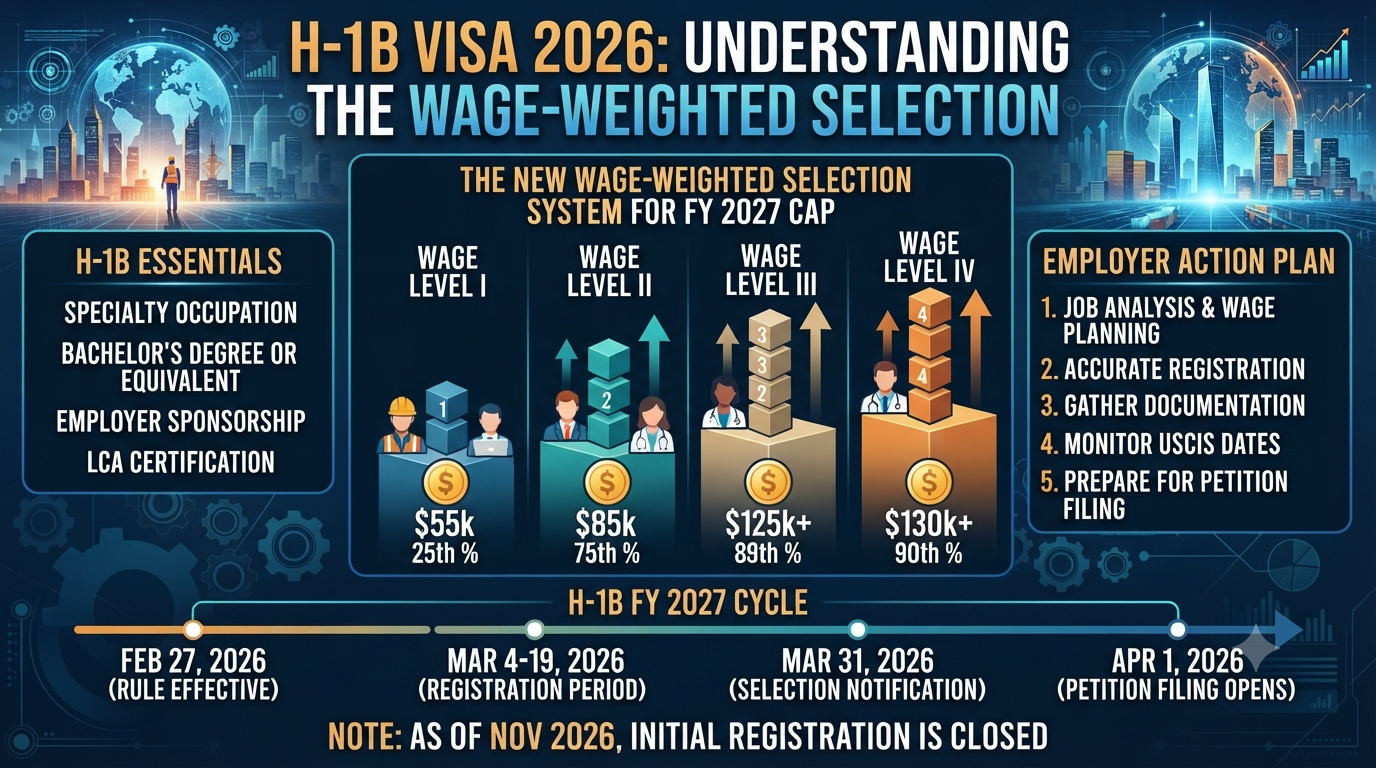
One of the biggest developments is the introduction of a wage-weighted selection system for the FY 2027 H-1B cap season. This change makes understanding the relationship between offered wages, occupational classifications, and registration information more important than ever.
Whether you are an employer planning to sponsor an international professional or a candidate preparing for an H-1B opportunity, understanding these developments can help you make better decisions.
Let’s explore the important H-1B updates and considerations for 2026.
1. What Is the H-1B Visa Program?
The H-1B visa is a U.S. nonimmigrant work visa that allows employers to hire qualified foreign professionals for specialty occupation positions.
A specialty occupation generally requires the theoretical and practical application of specialized knowledge and at least a bachelor’s degree in a directly related specific specialty, or its equivalent, as a minimum requirement for entry into the occupation.
Common industries that use the H-1B program include:
- Information Technology and Software Development.
- Engineering and Manufacturing.
- Healthcare and Medical Services.
- Financial Services and Banking.
- Scientific Research.
- Data Analytics and Technology Consulting.
The H-1B program allows eligible U.S. employers to access international talent while providing qualified foreign professionals with an opportunity to work in the United States.
2. Major H-1B Changes in 2026: The Wage-Weighted Selection System
One of the most significant H-1B developments in 2026 is the replacement of the traditional random selection process with a weighted selection system.
The new rule became effective on February 27, 2026, and applies beginning with the FY 2027 H-1B registration season.
Under this system, registrations are weighted according to the Department of Labor’s Occupational Employment and Wage Statistics (OEWS) wage levels for the relevant occupation and area of intended employment.
The general structure is:
- Wage Level I: One selection entry.
- Wage Level II: Two selection entries.
- Wage Level III: Three selection entries.
- Wage Level IV: Four selection entries.
Higher wage levels receive more entries in the selection process. However, a higher wage level does not guarantee selection.
Employers must identify the correct occupation, work location, and wage information when submitting registrations. Where multiple locations or positions apply, special rules determine the appropriate wage level.
This makes accurate job descriptions, salary planning, and registration documentation particularly important.
3. Understanding the FY 2027 H-1B Registration Process
The FY 2027 H-1B registration season introduced the new weighted selection system.
USCIS announced that the initial registration period ran from March 4 through March 19, 2026.
The registration fee was $215 per beneficiary.
On March 31, 2026, USCIS announced that it had received enough registrations to reach the regular H-1B cap and the advanced-degree exemption.
Selected employers were eligible to submit cap-subject petitions beginning April 1, 2026, within their individual filing windows.
As of November 2026, the initial FY 2027 registration period has already closed.
Employers and candidates preparing for a future cap season should monitor official USCIS announcements rather than relying on previous year’s dates.
4. Who Is Eligible for an H-1B Visa?
H-1B eligibility depends on the offered position, the applicant’s qualifications, and the petitioning employer’s ability to meet applicable requirements.
Generally, the following conditions must be satisfied:
Specialty Occupation Position
The offered position must qualify as a specialty occupation under applicable immigration regulations.
Educational Qualifications
The beneficiary generally needs a U.S. bachelor’s degree or higher in a directly related specific specialty, or an equivalent foreign degree or qualifying combination of education and experience.
Employer Sponsorship
A qualifying U.S. employer must file the H-1B petition on behalf of the foreign professional.
Labor Condition Application
The employer generally must obtain a certified Labor Condition Application (LCA) from the Department of Labor before filing the H-1B petition.
Supporting Documentation
The employer and beneficiary must provide appropriate documentation establishing eligibility, including information about the position, qualifications, and employment arrangements.
Meeting basic eligibility requirements does not automatically guarantee registration selection or petition approval.
5. The $100,000 H-1B Payment: What Employers Need to Understand
Another major development affecting H-1B employers is the September 2025 presidential proclamation introducing an additional $100,000 payment requirement for certain H-1B petitions.
This requirement is subject to specific applicability rules and exceptions.
It should not be assumed that every H-1B petition, extension, amendment, or change-of-status filing automatically requires this payment.
Employers should carefully review the applicable USCIS guidance and determine whether a particular petition is covered before proceeding.
Important considerations include:
- Whether the beneficiary is inside or outside the United States.
- Whether the petition involves consular notification or a change of status.
- The date the petition is filed.
- Whether an applicable exception exists.
- The beneficiary’s immigration circumstances.
Because the financial impact can be substantial, employers should evaluate the applicable rules before making sponsorship commitments.
6. Important Documents Required for an H-1B Petition
Preparing complete and accurate documentation is essential for a successful H-1B petition.
Depending on the applicant’s circumstances and petition type, commonly required documents may include:
Employer Documents
- Company information and business records.
- Job offer letter.
- Detailed job description.
- Certified Labor Condition Application.
- Supporting evidence of the specialty occupation.
- Wage and employment information.
Beneficiary Documents
- Valid passport information.
- Educational certificates.
- Academic transcripts.
- Resume or professional experience records.
- Previous employment documentation.
- Current immigration status documents, where applicable.
- Relevant visa and approval notices.
The exact documentation requirements can vary depending on the petition category and individual circumstances.
7. Common H-1B Mistakes Employers and Applicants Should Avoid
Even qualified candidates and legitimate employers can encounter problems when important filing details are overlooked.
Here are some common mistakes worth avoiding.
Incorrect Job Classification
Selecting an inaccurate occupational classification can create inconsistencies between the position, wage information, and registration.
Incorrect Wage Level Selection
Employers must use the applicable OEWS wage data and relevant selection rules rather than choosing a higher level simply to improve selection opportunities.
Inconsistent Registration and Petition Information
The information in the H-1B petition should be consistent with the selected registration, including relevant beneficiary and position details.
Incomplete Educational Documentation
Missing academic records, unclear degree equivalency evidence, or insufficient documentation can complicate eligibility review.
Missing Filing Deadlines
Employers must submit petitions within the filing period stated in the USCIS selection notice.
Ignoring Immigration Status
Applicants already in the United States should carefully evaluate their current immigration status and any applicable filing or status-maintenance requirements.
Careful preparation can help reduce avoidable filing problems.
8. What Should H-1B Applicants Do If They Are Not Selected?
Not receiving an H-1B selection notice can be
Comments