Introduction
The H-1B visa program continues to play an important role in helping U.S. employers recruit skilled international professionals for specialty occupations. Technology companies, engineering firms, financial institutions, healthcare organizations, and other businesses rely on H-1B workers to fill positions requiring specialized knowledge and qualifications.
However, the H-1B landscape is changing. For the Fiscal Year (FY) 2027 cap season, U.S. Citizenship and Immigration Services (USCIS) introduced a weighted selection process that gives greater selection weight to registrations associated with higher wage levels.
This development makes salary planning, job classification, registration accuracy, and immigration compliance even more important for employers and prospective H-1B beneficiaries.
In this guide, we explain the major H-1B developments in 2026, how the new selection process works, and what employers and applicants should understand when preparing for future H-1B opportunities.
1. What Is the H-1B Visa Program?
The H-1B visa is a nonimmigrant employment visa that allows U.S. employers to hire foreign professionals for specialty occupations.
A specialty occupation generally requires the theoretical and practical application of specialized knowledge and at least a bachelor’s degree in a directly related specific specialty, or its equivalent, as required by the applicable regulations.
Common H-1B occupations include:
- Software developers and engineers
- Data scientists and data analysts
- Financial analysts
- Electrical and mechanical engineers
- Healthcare professionals in qualifying roles
- IT consultants and cybersecurity specialists
- Research and scientific professionals
The standard annual H-1B cap is 65,000 visas, with an additional 20,000 places available for qualifying beneficiaries who hold a U.S. master’s degree or higher from an eligible institution.
Certain employers and qualifying petitions may be exempt from the annual numerical cap.
2. Major H-1B Change in 2026: The Weighted Selection Process
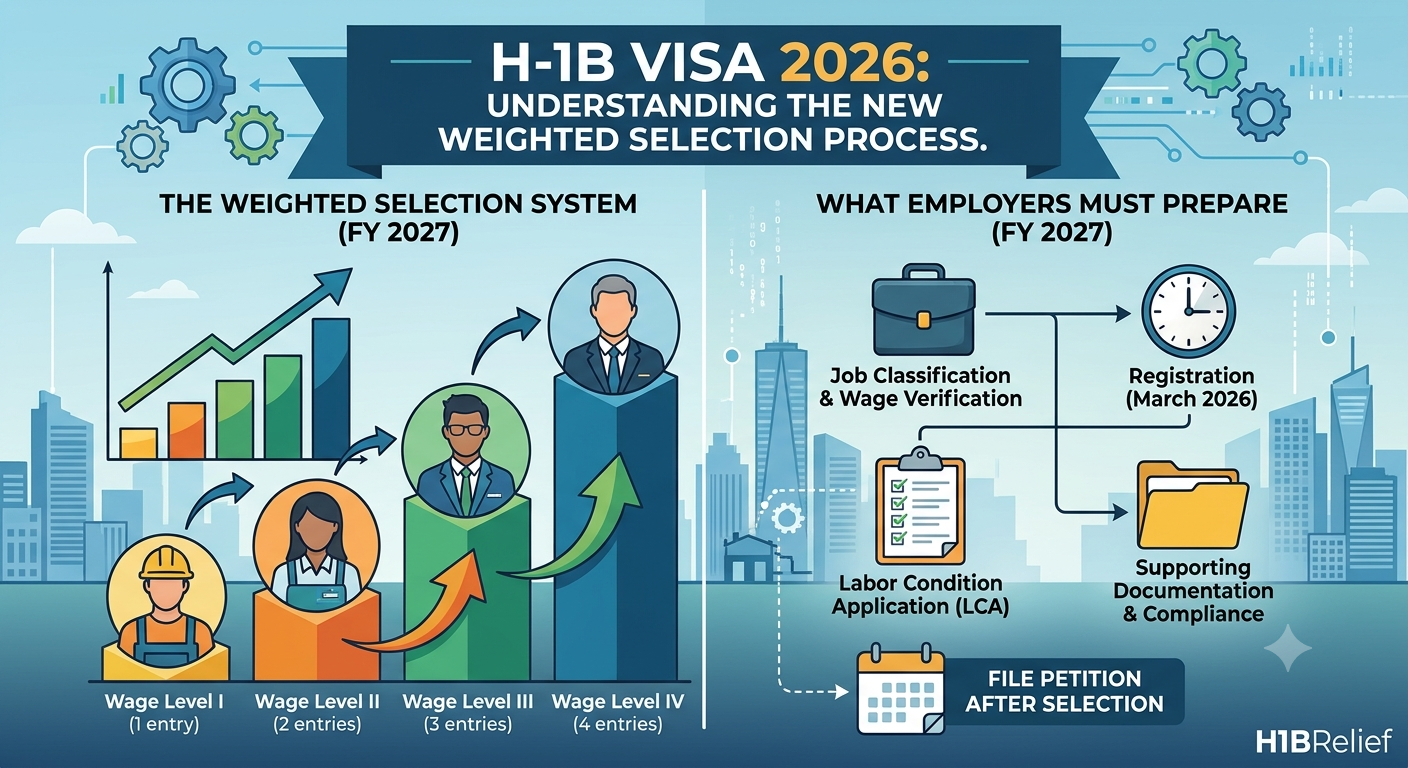
One of the most important developments for the FY 2027 H-1B cap season is the introduction of a weighted selection process.
Under the previous random selection approach, eligible registrations generally had the same chance of selection, regardless of the offered wage level.
The new process gives greater selection weight to registrations associated with higher wage levels under the Department of Labor’s Occupational Employment and Wage Statistics (OEWS) framework.
In practical terms, wage levels influence how many entries a beneficiary receives in the selection process.
The general weighting structure is:
- Wage Level I: One entry
- Wage Level II: Two entries
- Wage Level III: Three entries
- Wage Level IV: Four entries
This approach is intended to prioritize higher-skilled and higher-paid positions while maintaining opportunities across different wage levels.
Important: A higher wage level does not guarantee selection. It changes the number of entries associated with an eligible registration, but selection remains subject to the applicable USCIS process and annual cap.
3. FY 2027 H-1B Registration: Important Dates and Fees
USCIS announced the FY 2027 initial H-1B registration period with the following schedule:
| Registration detail | FY 2027 information |
|---|---|
| Registration opens | March 4, 2026 |
| Registration closes | March 19, 2026 |
| Registration fee | $215 per beneficiary |
| Selection notifications | Intended by March 31, 2026 |
| Registration platform | USCIS online account |
The initial registration period has now passed. Employers whose registrations were selected could proceed with filing eligible H-1B cap-subject petitions within the applicable filing period.
Employers planning for a future cap season should prepare their documentation, verify job details, and monitor official USCIS announcements rather than relying on previous-year deadlines.
4. Why Wage Levels Matter More Than Before
Wage levels are becoming an important part of H-1B cap planning because they affect the weighted selection process.
Employers should understand that wage-level classification is not simply a matter of choosing a higher category to improve selection chances.
The appropriate wage level depends on factors such as:
- The occupation and relevant Standard Occupational Classification (SOC) code
- The geographic area of intended employment
- The offered wage
- The position’s duties and requirements
- The applicable prevailing wage information
Employers must ensure that the wage and job details reported during registration are consistent with the supporting petition and Labor Condition Application (LCA).
For example, an employer registering a software developer should carefully evaluate the actual job responsibilities, appropriate occupational classification, work location, and offered salary before selecting the corresponding wage level.
An inaccurate classification or unsupported wage level can create compliance concerns and potentially affect the petition.
5. H-1B Employer Responsibilities: What Businesses Should Review
Employers sponsoring H-1B professionals have responsibilities that extend beyond submitting an online registration.
A well-prepared H-1B petition should be supported by accurate employment information and appropriate documentation.
A. Verify the Specialty Occupation
The employer should establish that the offered position qualifies as a specialty occupation under the applicable H-1B requirements.
The job description should clearly explain the specialized duties, required knowledge, and educational qualifications.
B. Review the Prevailing Wage
Employers must comply with applicable wage requirements. Generally, the required wage is the higher of the actual wage paid to similarly employed workers or the prevailing wage for the occupation and area of employment.
C. Prepare the Labor Condition Application
Before filing the H-1B petition, the employer generally needs an approved Labor Condition Application (LCA) from the Department of Labor.
The LCA includes important information about the occupation, work location, wage, and employer attestations.
D. Maintain Supporting Documentation
Employers should maintain relevant records, including:
- Job descriptions and employment agreements
- Wage information and payroll records
- Worksite details
- LCA documentation
- Evidence supporting the specialty occupation
- Required public access file documentation
E. Ensure Consistency Across Documents
The registration, LCA, Form I-129, and supporting evidence should accurately reflect the same underlying employment arrangement.
Changes in job duties, work locations, or other material employment details should be reviewed carefully to determine whether an amended petition or other action is required.
6. H-1B Applicants: How to Prepare for Future Opportunities
The new weighted selection system makes it important for applicants to understand the position and employer sponsoring their registration.
Although the employer generally manages the registration and petition process, applicants can take practical steps to prepare.
Review your qualifications: Make sure your degree, academic records, and professional experience support the offered specialty occupation.
Understand the job description: Your educational background should have an appropriate relationship to the position’s specialized requirements.
Verify employer information: Understand the sponsoring company’s business, offered role, work location, and employment arrangement.
Keep your documents ready: Maintain updated educational certificates, transcripts, passport information, employment records, and other relevant documents.
Be cautious of unrealistic promises: No employer, recruiter, or consultant can guarantee H-1B selection or visa approval.
Applicants should also understand that selection in the registration process is not the same as approval of the H-1B petition or issuance of a visa.
7. H-1B Fees and Immigration Cost Planning in 2026
H-1B employers should review the applicable USCIS fee schedule before submitting a petition.
The total cost may depend on factors such as:
- Registration fees
- Form I-129 filing fees
- Fraud Prevention and Detection fees, when applicable
- ACWIA fees, when applicable
- Additional fees based on employer size and circumstances
- Optional premium processing fees
Certain presidential proclamation-related payment requirements and proposed regulatory fee changes have also affected the H-1B policy landscape.
For example, a separate DHS proposal published in August 2026 discussed an additional $103,265 fee for certain H-1B cap-subject petitions. This was a proposed rule, not a fee that should automatically be treated as a final, universally applicable requirement.
Employers should verify the current legal status of any proposed rule, applicable court decisions, presidential proclamations, and USCIS fee instructions before budgeting or filing.
8. Common H-1B Mistakes Employers and Applicants Should Avoid
Even a strong candidate or genuine job opportunity can face problems when the application is not properly prepared.
Some common mistakes include:
- Selecting an inappropriate occupational classification.
- Reporting an unsupported wage level.
- Providing inconsistent job information across registration and petition documents.
- Using incomplete or inaccurate employer information.
- Failing to review worksite and employment arrangements.
- Missing filing deadlines after selection.
- Assuming registration selection guarantees petition approval.
- Relying on outdated fee information or immigration guidance.
A careful review before filing can help reduce avoidable errors and support a more organized immigration process.
9. What Should Employers Expect from the H-1B Program Going Forward?
The FY 2027 weighted selection process highlights the importance of accurate wage information, genuine job opportunities, and stronger preparation.
Employers should expect greater attention to the relationship between job duties, occupational classification, offered wages, and supporting documentation.
For businesses that regularly sponsor international professionals, H-1B planning should become part of their broader workforce strategy.
This includes:
- Reviewing upcoming hiring requirements early
- Evaluating qualifying specialty occupation positions
- Planning competitive and compliant compensation
- Maintaining accurate employment records
- Monitoring USCIS and Department of Labor updates
- Working with qualified immigration counsel on complex cases
Being proactive can help employers make informed decisions and prepare for future H-1B filing opportunities.
Frequently Asked Questions About the H-1B Visa in 2026
1. What is the new H-1B weighted selection process?
The FY 2027 H-1B selection process assigns different numbers of entries based on the applicable OEWS wage level. Higher wage levels receive more entries, but selection is not guaranteed.
2. What was the H-1B registration fee for FY 2027?
The USCIS registration fee for the FY 2027 initial registration period was $215 per beneficiary.
3. Does a higher salary guarantee H-1B selection?
No. A higher qualifying wage level may provide more entries under the weighted selection process, but it does not guarantee selection or petition approval.
4. Can an employer register the same candidate multiple times?
The beneficiary-centric selection system is designed to select based on unique beneficiaries rather than simply rewarding multiple registrations. Employers must follow USCIS registration requirements and provide accurate information.
5. What is an H-1B prevailing wage?
The prevailing wage is the wage determined for a particular occupation in a specific geographic area. Employers must generally pay at least the required wage, which is the higher of the actual wage or prevailing wage.
6. What happens after an H-1B registration is selected?
The employer may file an H-1B petition during the applicable filing period. The petition must include the required forms, fees, LCA, and supporting evidence. Selection alone does not mean the petition is approved.
7. Are all H-1B employers subject to the annual lottery?
No. Certain qualifying institutions, nonprofit organizations, research organizations, and other eligible petitioners may qualify for cap-exempt treatment under the applicable rules.
8. Can an H-1B employee change employers?
Yes, in many circumstances an H-1B worker can change employers through the applicable H-1B portability and petition process. Eligibility and timing depend on the individual’s immigration history and circumstances.
9. Is the proposed $103,265 H-1B fee applicable to every employer?
No. The August 2026 Federal Register publication described a proposed fee for certain H-1B cap-subject petitions. Employers should verify whether any final rule has been issued and whether it applies to their specific filing.
10. Where can employers check official H-1B updates?
Employers and applicants should consult the official USCIS website, the Department of Labor, and the Federal Register for current requirements, announcements, forms, and fee information.
Conclusion
The H-1B visa program is evolving, and the FY 2027 weighted selection process represents an important change for U.S. employers and international professionals.
Wage levels, occupational classification, registration accuracy, and supporting documentation now deserve even more attention during H-1B planning. Employers should avoid relying on outdated procedures and should review current government guidance before making immigration-related decisions.
Whether you are an employer preparing to sponsor international talent or a professional exploring H-1B opportunities, staying informed is an important step toward making better decisions.
H1BRelief aims to help readers understand H-1B immigration topics, follow important policy developments, and find useful information about the U.S. employment-based immigration process.
Comments