Introduction
For international professionals planning to work in the United States, the H-1B visa remains an important pathway to employment in specialized occupations.
However, navigating the H-1B process requires more than finding an employer willing to sponsor a visa. Applicants and employers must understand eligibility requirements, registration procedures, documentation, filing deadlines, and changing immigration policies.
In 2026, H-1B planning has become particularly important as the U.S. government introduces changes to the selection process and strengthens program integrity requirements.
For applicants, preparation means understanding their qualifications, employment opportunities, and immigration timelines. For employers, it means ensuring that job positions, wage information, and supporting documentation are properly aligned.
A well-organized approach can help both parties reduce avoidable mistakes and prepare for the complexities of employment-based immigration.
What Is the H-1B Visa?
The H-1B visa is a U.S. nonimmigrant classification that allows employers to hire eligible foreign professionals for specialty occupation positions.
A specialty occupation generally requires the theoretical and practical application of specialized knowledge and a bachelor’s degree or higher in a directly related specific specialty, or its equivalent, as required by the applicable regulations.
Common industries that use H-1B sponsorship include:
- Information technology
- Software engineering
- Healthcare and medical technology
- Engineering
- Financial services
- Scientific research
- Data analytics
- Business and technology consulting
The H-1B program is employer-sponsored. An eligible employer generally files the petition on behalf of the prospective employee.
The applicant’s education, professional background, proposed job, and employer’s supporting documentation all play an important role in establishing eligibility.
H-1B Visa Changes in 2026: Why Preparation Matters
The H-1B program has undergone significant changes in recent years.
For the FY 2027 cap season, a new weighted selection process became effective on February 27, 2026. The process generally gives greater weight to registrations associated with higher offered wage levels while maintaining opportunities for employers at different wage levels. <Cite refs={[“turn322604search1″,”turn322604search5”]}/>
This means employers should pay particular attention to the relationship between:
- The offered salary
- The occupation’s wage classification
- The intended employment location
- The actual job responsibilities
- The information submitted during registration
A higher wage level does not guarantee selection or petition approval.
Employers must ensure that wage information is accurate and reflects the actual position rather than attempting to manipulate the selection process.
Understanding the FY 2027 Registration Process
USCIS announced that the FY 2027 H-1B registration period ran from March 4 through March 19, 2026.
The initial selection process was completed on March 31, 2026. Selected employers could begin filing eligible cap-subject petitions on April 1, 2026, within the applicable filing period. <Cite refs={[“turn322604search0″,”turn322604search2”]}/>
For individuals planning future H-1B applications, this reinforces the importance of preparing well before registration opens.
Applicants should not wait until the registration period begins to discuss sponsorship with a prospective employer.
H-1B Visa Eligibility Requirements
Eligibility depends on the specific position, applicant qualifications, and applicable immigration rules.
1. Specialty Occupation Position
The offered job must meet the applicable specialty occupation requirements.
The employer should be able to explain why the position requires specialized knowledge and the relevant educational background.
2. Educational Qualifications
Applicants typically need a bachelor’s degree or higher in a directly related specialty, or an acceptable equivalent qualification.
Foreign educational credentials may require evaluation to establish their U.S. equivalency.
3. Employer Sponsorship
An eligible U.S. employer must generally file the H-1B petition.
The employer is responsible for providing the required employment information and supporting documentation.
4. Position and Wage Information
The offered position, work location, wage information, and job responsibilities must be consistent with the applicable requirements.
Employers should carefully review these details before submitting registration or petition documents.
5. Petition Approval
H-1B registration selection is not the same as petition approval.
A selected registration generally provides the opportunity to file a cap-subject petition, but the employer must still establish eligibility for approval. <Cite refs={[“turn322604search2″,”turn322604search3”]}/>
H-1B Visa Checklist for Applicants
Preparing documentation early can help applicants avoid unnecessary delays.
Here is a practical checklist.
Educational Documents
Applicants should organize:
- Bachelor’s or master’s degree certificates
- Academic transcripts
- Foreign credential evaluations, when appropriate
- Relevant professional certifications
- Supporting evidence of equivalent qualifications, if applicable
Employment Documents
Depending on the circumstances, useful documents may include:
- Updated resume
- Previous employment verification letters
- Detailed job descriptions
- Professional experience records
- Current employment information
- Relevant technical or professional certifications
Identity and Immigration Documents
Applicants should also review:
- Valid passport or travel document
- Current immigration status documents
- Previous visa records
- I-94 admission records, where applicable
- Existing employment authorization documents
- Relevant prior immigration filings
The exact documents required depend on the individual’s immigration history and the specific petition.
Applicants should follow the instructions provided by their employer and qualified immigration counsel.
H-1B Planning for F-1 Students
International students studying in the United States may consider H-1B sponsorship as part of their long-term career planning.
However, an H-1B registration or petition does not automatically extend a student’s employment authorization.
Students should understand the relationship between their F-1 status, Optional Practical Training (OPT), STEM OPT eligibility where applicable, and potential H-1B sponsorship.
Important considerations include:
Understand Employment Authorization
Students should carefully track the validity dates of their employment authorization documents.
Working without appropriate authorization can create serious immigration consequences.
Discuss Sponsorship Early
Students interested in H-1B sponsorship should discuss their plans with their employer well before the relevant registration period.
Early communication can help employers evaluate sponsorship requirements and prepare documentation.
Review Potential Status Transitions
The timing of an H-1B petition and the applicant’s current immigration status may affect the available options.
Applicants should obtain individualized legal guidance before making decisions about employment, travel, or changes in immigration status.
H-1B Employer Sponsorship: What Businesses Should Prepare
Employers play a central role in the H-1B process.
A strong sponsorship process requires coordination between HR, hiring managers, payroll, and immigration professionals.
Define the Job Position Clearly
Employers should prepare a detailed job description explaining the position’s responsibilities, required knowledge, and educational requirements.
A vague job description can make it more difficult to establish that a position qualifies as a specialty occupation.
Review Wage Information
Employers should review the offered salary and applicable wage requirements.
The position’s wage information should be consistent with the occupation, work location, and actual job responsibilities.
Prepare Supporting Documentation
Depending on the petition, employers may need to provide:
- Company information
- Job descriptions
- Employment agreements
- Wage documentation
- Work location details
- Supporting business records
- Evidence of the proposed employment
Coordinate With Immigration Counsel
Immigration counsel can help employers review eligibility, filing requirements, deadlines, and supporting evidence.
Early coordination can help reduce avoidable errors and improve the overall sponsorship workflow.
Common H-1B Visa Mistakes to Avoid
Waiting Until the Last Minute
Late preparation can create problems with documentation, employer coordination, and filing deadlines.
Applicants and employers should plan well in advance.
Assuming Selection Guarantees Approval
Selection allows an eligible employer to proceed with filing a cap-subject petition. It does not guarantee approval.
Providing Inconsistent Information
Differences between registration details, job descriptions, wage information, and petition documents can create unnecessary complications.
All submitted information should be reviewed for consistency.
Ignoring Immigration Status Deadlines
Applicants should carefully monitor the validity of their current immigration status and employment authorization.
Relying on Unverified Information
Immigration policies can change.
Applicants should rely on official USCIS information and qualified immigration professionals rather than outdated online discussions or unsupported promises.
How H1BRelief Supports H-1B Visa Planning
H-1B immigration planning can involve a substantial amount of documentation, coordination, and deadline management.
H1BRelief can help readers explore H-1B visa information, understand common immigration processes, and identify important preparation considerations.
For individuals and employers navigating employment-based immigration, a clear understanding of the process can make it easier to organize documentation and communicate with the appropriate professionals.
Whether an applicant is exploring sponsorship opportunities or an employer is preparing for a future H-1B season, informed preparation is an important first step.
Visit https://h1brelief.com/ to learn more.
The Future of H-1B Visa Planning
The H-1B program continues to evolve as the U.S. government updates immigration regulations and administrative procedures.
For applicants, this means understanding eligibility, preparing documents, and maintaining appropriate immigration status.
For employers, it means reviewing sponsorship procedures, wage information, and compliance responsibilities.
The most effective approach is to remain informed, prepare early, and seek qualified guidance when individual circumstances require legal analysis.
Conclusion
The H-1B visa process can create valuable employment opportunities for qualified international professionals and U.S. employers.
However, successful planning requires a clear understanding of eligibility requirements, employer sponsorship, documentation, and changing immigration procedures.
The FY 2027 H-1B selection process introduced a weighted selection system, making accurate wage and registration information particularly important for employers and applicants. <Cite refs={[“turn322604search1″,”turn322604search7”]}/>
By preparing early, organizing supporting documents, and staying informed through official immigration resources, applicants and employers can approach the H-1B process with greater clarity.
H1BRelief provides a resource for individuals seeking to understand H-1B visa planning and employment-based immigration topics.
Planning your H-1B journey? Explore H1BRelief for helpful information and resources to guide your next steps.
Frequently Asked Questions
What is the H-1B visa?
The H-1B visa is a U.S. nonimmigrant classification that allows eligible employers to hire foreign professionals for qualifying specialty occupation positions.
What changed in the H-1B selection process in 2026?
For FY 2027, USCIS implemented a weighted selection process that generally gives greater weight to registrations associated with higher offered wage levels. Selection is not guaranteed at any wage level. <Cite refs={[“turn322604search1″,”turn322604search5”]}/>
Does H-1B registration selection guarantee visa approval?
No. Selection generally allows an eligible employer to file a cap-subject petition. The petition must still establish eligibility for approval. <Cite refs={[“turn322604search2″,”turn322604search3”]}/>
Can F-1 students apply for H-1B sponsorship?
F-1 students may be eligible for employer-sponsored H-1B petitions if they meet the applicable requirements. Their current immigration status and employment authorization must also be considered.
What documents are needed for an H-1B petition?
Documents may include educational records, employment information, passport details, job descriptions, wage information, and supporting employer documentation. Requirements depend on the specific case.
When should applicants start preparing for H-1B sponsorship?
Applicants should discuss sponsorship with prospective employers well before the relevant registration period. Early preparation can help employers and applicants organize documents and evaluate eligibility.
SEO Metadata
Meta Title: H-1B Visa 2026: Requirements & Planning Guide | H1BRelief
Meta Description: Learn about H-1B visa requirements, employer sponsorship, 2026 selection changes, documentation, and practical planning tips for applicants and employers.
Suggested URL Slug: /h1b-visa-planning-2026/
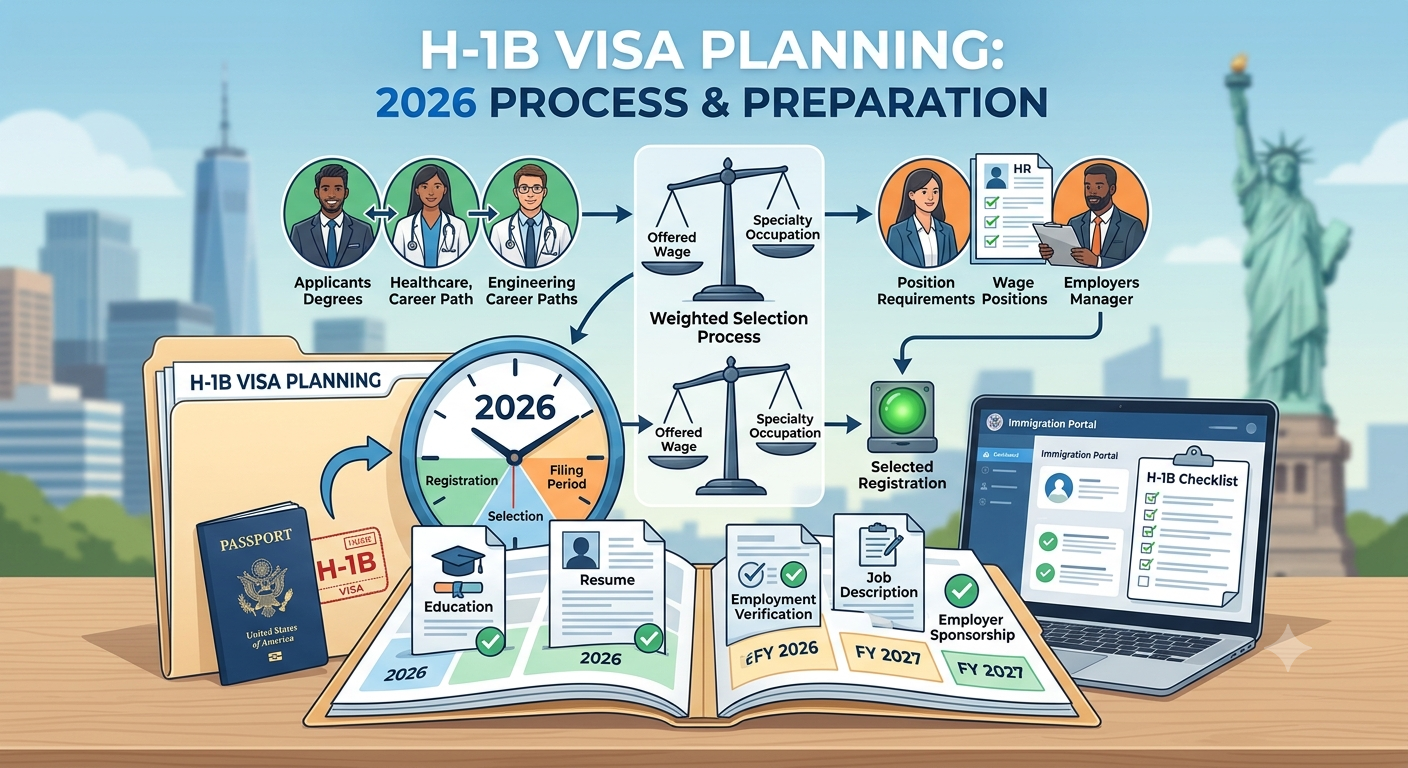
Suggested Feature Image Alt Text: H-1B visa planning guide illustrating U.S. immigration documents, professional employment, and visa application preparation.
Suggested Internal Links:
- H-1B Visa Requirements
- H-1B Visa Process
- H-1B Employer Sponsorship
- H-1B Visa Documentation
- H-1B Visa FAQs
Suggested CTA: Prepare for Your H-1B Journey With H1BRelief
Editorial Disclaimer: This article is for general informational purposes only and does not constitute legal advice. Immigration rules and individual eligibility can change. Readers should consult official USCIS resources and qualified immigration counsel for advice on their specific circumstances.
Comments