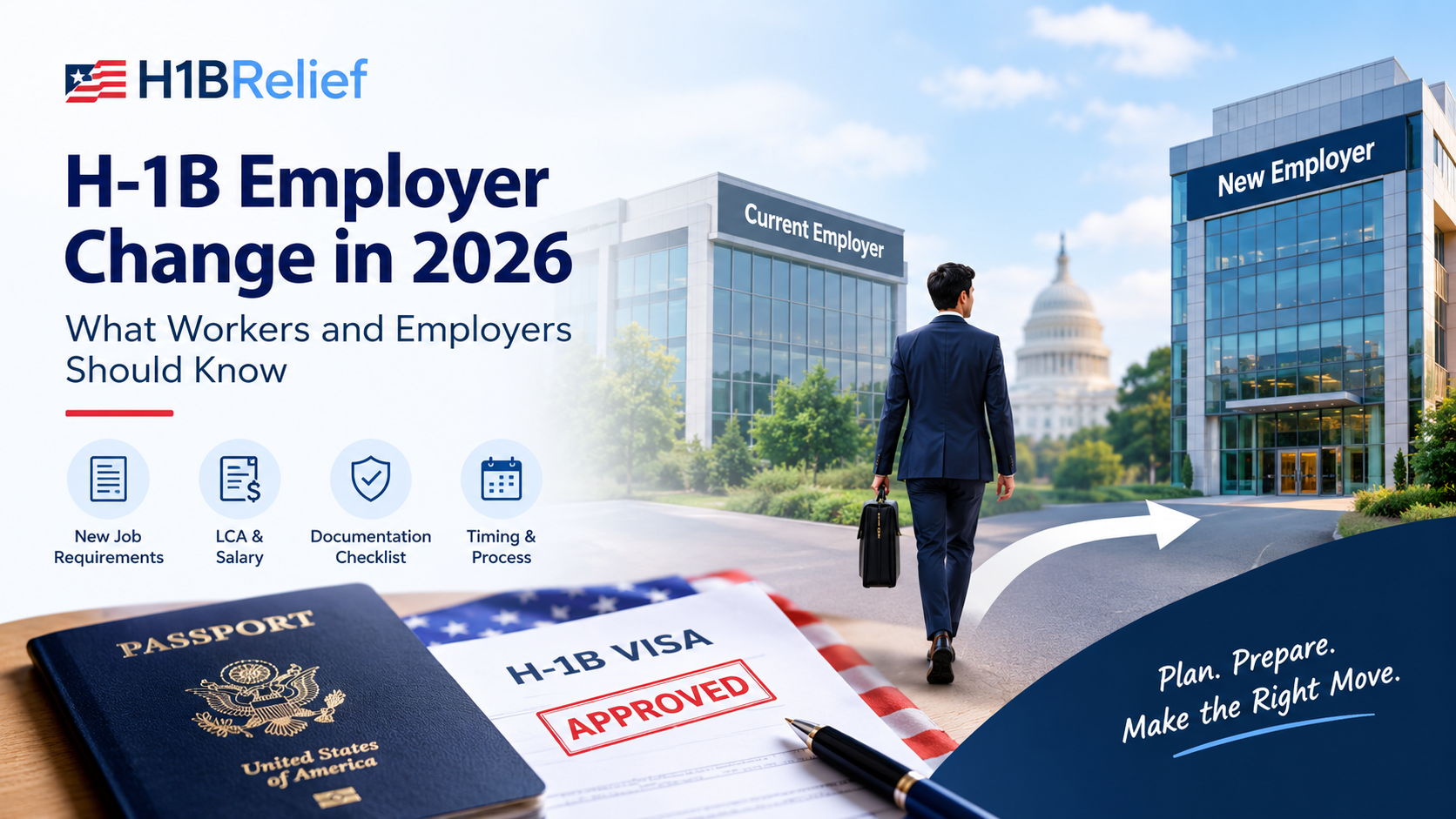
Changing jobs while working in the United States on H-1B status involves more than simply accepting a new employment offer.
The new employer generally needs to understand the H-1B petition process, the offered position, wage requirements, work location, documentation, and the timing of the filing.
For H-1B workers, understanding these requirements before changing employers can help make the transition more organized and reduce avoidable problems.
This guide explains important considerations for H-1B employer changes in 2026.
What Happens When an H-1B Worker Changes Employers?
H-1B status is tied to specific employment circumstances rather than being a general work authorization that can be used for any employer.
When a new employer wants to employ an H-1B worker, the employer generally needs to file the appropriate petition with U.S. Citizenship and Immigration Services (USCIS).
USCIS explains that employers may file Form I-129 for qualifying H-1B employment, including employment in a specialty occupation.
The new employer should therefore evaluate the position and prepare the required documentation before the employee begins the new role.
What Is H-1B Portability?
H-1B portability can allow certain H-1B workers who meet the applicable requirements to begin employment with a new employer after the new employer properly files a qualifying petition.
However, portability has specific legal requirements and should not be treated as an automatic right to start any new job immediately.
The timing of the petition, the worker’s existing H-1B status, and the circumstances of the new employment all matter.
Because individual situations can differ, workers considering a job change should review their circumstances with a qualified immigration professional.
Why the New Job Description Matters
One of the important parts of an H-1B petition is the position being offered.
The employer needs to establish that the offered position qualifies under the applicable H-1B requirements.
For specialty occupation cases, USCIS describes criteria involving the nature of the position and the specialized knowledge associated with the role.
A strong job description should clearly explain:
- Job title
- Primary responsibilities
- Required skills
- Educational requirements
- Technical knowledge
- Work location
- Salary
- Employer information
- Relationship between the employee’s qualifications and the position
A vague description may make it more difficult to clearly demonstrate how the position meets the applicable requirements.
Salary and LCA Considerations
The Labor Condition Application (LCA) is an important part of the H-1B employment process.
USCIS materials explain that the LCA identifies information such as the job, wage, employment period, and geographic location. The employer must generally agree to pay the required wage under the applicable rules.
When changing employers, the new employer therefore needs to carefully review:
- Offered salary
- Job classification
- Work location
- Employment conditions
- Applicable wage requirements
Changes in these factors can affect the petition and may require additional analysis.
What Documents May Be Needed?
The exact documentation varies by case and employer, but an H-1B employer-change process may involve documents such as:
Employee Documents
- Passport
- Current immigration documents
- Current H-1B approval notice
- Visa information, where applicable
- Resume
- Educational documents
- Previous immigration records
- Current employment information
Employer Documents
- Company information
- Job offer
- Detailed job description
- Salary information
- Work location
- LCA documentation
- Supporting business documentation
Additional evidence may be appropriate depending on the case.
Changing Jobs Does Not Always Mean Starting From Zero
An H-1B worker who changes employers may already have an established immigration history.
The new employer’s petition may involve the worker’s existing H-1B status and prior immigration documentation.
This makes accurate recordkeeping particularly important.
Workers should maintain copies of:
- Previous H-1B approval notices
- I-94 records
- Passport and visa documents
- Previous petitions
- Employment records
- Educational records
- Immigration correspondence
Keeping these documents organized can make future immigration processes easier.
What About a Change in Work Location?
A change in employment location can be an important consideration.
The LCA and H-1B petition are connected to the employment circumstances presented to the government.
For example, moving from one metropolitan area to another may require the employer to review whether additional filings or compliance steps are necessary.
Remote and hybrid work arrangements can also create questions about the appropriate work location.
Employers should review location changes before implementing them rather than assuming that every remote-work arrangement is automatically covered.
What If the Job Duties Change?
An H-1B worker may receive a promotion or move into a different role.
But a significant change in job duties can raise immigration questions.
For example, changes involving:
- Job responsibilities
- Occupational classification
- Work location
- Employer structure
- Employment terms
may require an immigration review.
The safest approach is to evaluate significant employment changes before they occur.
What Should Employers Do Before Hiring an H-1B Worker?
Employers can create a structured process for H-1B hiring.
Step 1: Review the Position
Define the actual job duties and requirements.
Step 2: Review the Candidate
Confirm the employee’s education, experience, and immigration history.
Step 3: Review Wage and Location Requirements
Evaluate the salary, worksite, and applicable LCA requirements.
Step 4: Prepare Documentation
Collect the employer and employee documents required for the petition.
Step 5: File the Appropriate Petition
Prepare and submit the applicable immigration filing.
Step 6: Track the Case
Maintain records of the filing, notices, deadlines, and employment information.
This structured approach can help employers manage H-1B employment more consistently.
Common Mistakes to Avoid
H-1B employer changes can become complicated when important details are overlooked.
Common issues can include:
1. Starting the New Job Without Reviewing Filing Requirements
Workers should understand the applicable rules before changing employment.
2. Using an Inaccurate Job Description
The petition should accurately describe the actual position.
3. Ignoring Work Location Changes
Changes in where the employee works can have immigration implications.
4. Losing Previous Immigration Records
Prior approval notices and immigration documents can be important for future filings.
5. Treating Every H-1B Case the Same
Immigration requirements can vary depending on the worker, employer, position, and circumstances.
H-1B Registration Is Different From an Employer Change
H-1B workers and employers should distinguish between the cap-subject registration process and an employer-change petition.
USCIS explains that a prospective petitioner seeking an H-1B worker subject to the numerical allocations generally submits an electronic registration during the designated registration period. USCIS also states that a registrant may submit only one registration per beneficiary in a fiscal year.
An existing H-1B worker changing employers may be dealing with a different process from someone entering the H-1B cap process for the first time.
Understanding which process applies is therefore important.
Why Professional Guidance Can Matter
H-1B rules can involve multiple agencies, forms, deadlines, employment conditions, and factual requirements.
A case involving a straightforward employer change may look very different from one involving:
- A new occupation
- A significant worksite change
- An amended petition
- Expiring status
- Multiple employers
- Complicated employment history
- Previous immigration issues
Professional immigration guidance can help identify which requirements apply to a particular situation.
How H1BRelief Can Help
H1BRelief provides information and support resources for professionals navigating the H-1B process.
The platform can help users better understand topics such as:
- H-1B visa processes
- Employer changes
- H-1B documentation
- Immigration timelines
- Employment-related immigration questions
- H-1B compliance considerations
- General immigration resources
For case-specific legal advice, individuals should consult a qualified U.S. immigration attorney or other authorized professional.
Final Thoughts
Changing H-1B employers is an important employment and immigration event.
The process can involve the new employer’s petition, job duties, wage requirements, work location, documentation, and the worker’s existing immigration status.
The key is to avoid treating an employer change as a simple job transition.
Review the position. Review the employer. Review the documentation. Review the timing.
Understanding the applicable requirements before making a change can help H-1B workers and employers approach the transition in a more organized way.
SEO Keywords
- H-1B employer change 2026
- H-1B transfer 2026
- H-1B transfer process
- H-1B portability
- change employer on H-1B
- H-1B visa transfer
- H-1B job change
- H-1B employer transfer
- H-1B petition
- H-1B LCA
- H-1B immigration support
- H-1B visa USA
- H-1B visa process
- H-1B attorney
- H-1B immigration services
Meta Title
H-1B Employer Change & Transfer Guide 2026 | H1BRelief
Meta Description
Learn what H-1B workers and employers should know about employer changes, portability, job duties, LCA requirements, documentation, and petition considerations in 2026.
Suggested URL Slug
/blogs/h1b-employer-change-transfer-guide-2026/
Important Note
This article is for general informational purposes and is not legal advice. H-1B requirements can depend on the specific facts of an individual’s case. Consult a qualified U.S. immigration attorney for case-specific guidance.
Comments