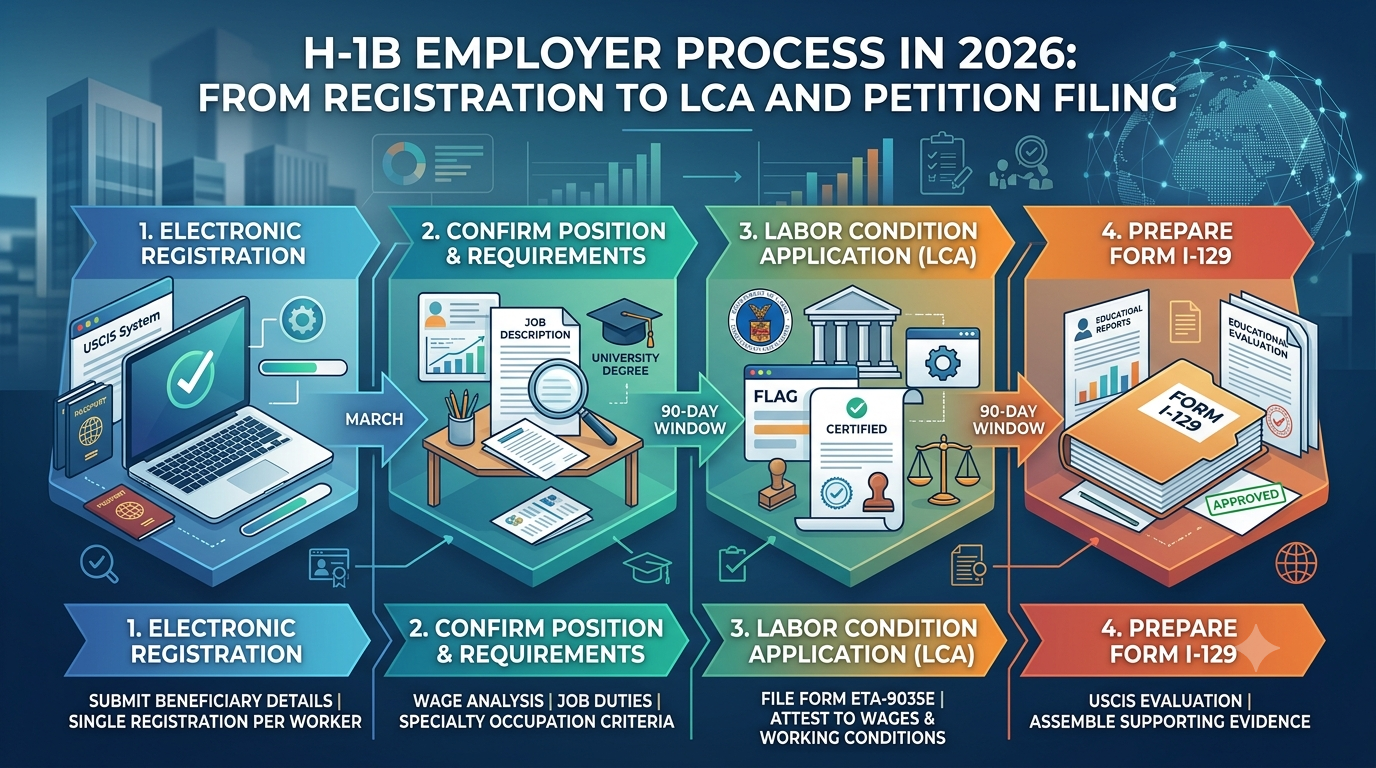
The H-1B visa process involves more than an employee finding a U.S. job and an employer submitting paperwork. For cap-subject cases, employers generally move through several stages, including electronic registration, selection when applicable, Labor Condition Application (LCA) requirements, and the H-1B petition process.
For employers and foreign professionals navigating the H-1B visa process in 2026, understanding the sequence can make it easier to organize documents, identify responsibilities, and avoid preventable filing problems.
Important: H-1B rules, fees, forms, filing procedures, and government guidance can change. This article provides general information and is not legal advice.
What Is the H-1B Visa?
The H-1B classification allows U.S. employers to seek temporary employment authorization for qualifying foreign workers in specialty occupations, subject to the applicable statutory and regulatory requirements.
The process involves multiple government agencies and can require coordination between the employer, employee, immigration professionals, USCIS, and the U.S. Department of Labor.
For cap-subject H-1B cases, the electronic registration process is an important first stage.
Step 1: H-1B Electronic Registration
A U.S. employer or qualifying agent seeking to file a cap-subject H-1B petition generally must first submit an electronic registration during the designated USCIS registration period.
USCIS states that a prospective petitioner may submit only one registration per beneficiary in a fiscal year. The registration process requires information about the prospective beneficiary and includes passport-related information.
Registration itself does not mean an H-1B petition has been approved.
If USCIS receives enough registrations to meet the projected numerical allocation, it conducts the applicable selection process. A selected registration can then provide the petitioner with eligibility to proceed with the H-1B petition, subject to the applicable requirements.
Step 2: Confirm the Position and H-1B Requirements
After registration selection, the employer needs to prepare the underlying petition carefully.
Important areas can include:
- The offered position
- Job duties
- Work location
- Salary
- Employer information
- Beneficiary qualifications
- Specialty-occupation requirements
- Employer-employee relationship
- Required supporting documentation
The petition should present a consistent picture of the proposed employment.
Differences between the job description, wage information, work location, beneficiary credentials, and supporting documents can create questions during adjudication.
Step 3: Labor Condition Application
The Labor Condition Application (LCA) is an important part of the H-1B employer process.
The U.S. Department of Labor explains that employers generally must submit an LCA before filing the H-1B petition with USCIS or obtaining an H-1B visa through the Department of State. The LCA is filed electronically through the FLAG system, subject to limited exceptions.
The employer makes several attestations through the LCA.
These include requirements concerning wages and working conditions.
Understanding the H-1B Wage Requirement
Under the H-1B rules, the employer generally must pay at least the required wage applicable to the employment.
The Department of Labor describes the required wage as the greater of the applicable actual wage or prevailing wage, subject to the program’s rules.
This makes wage analysis an important part of H-1B preparation.
Employers should ensure that the information used in the LCA is accurate and consistent with the offered employment.
Work Location Matters
The location where an H-1B employee works can be important for the LCA and petition.
Employers should carefully evaluate:
- Primary worksite
- Additional work locations
- Remote or hybrid arrangements
- Client sites
- Relocation plans
- Changes in employment location
The employer’s obligations can depend on the circumstances and applicable rules.
Because work arrangements can change after filing, employers should review immigration requirements before making significant changes to an H-1B employee’s work location or role.
Step 4: Prepare Form I-129
Once the applicable LCA requirements are addressed, the employer can proceed with the H-1B petition process.
Form I-129, Petition for a Nonimmigrant Worker, is used for H-1B petitions.
The petition package may include documentation related to:
- The employer
- The offered position
- The beneficiary
- Educational qualifications
- The LCA
- Employment terms
- Company information
- Supporting evidence
USCIS evaluates the petition under the applicable H-1B requirements.
What Makes a Strong H-1B Petition?
A well-organized petition should clearly connect the major parts of the case.
For example:
Job Duties → Specialty Occupation → Required Qualifications → Beneficiary Education/Experience → Employer Documentation → LCA
The evidence should tell a consistent story about the position and the person being sponsored.
Job Description
The job description should accurately describe the actual position rather than relying on generic language.
Educational Requirements
The employer should clearly explain the education or equivalent qualifications required for the position.
Beneficiary Qualifications
The beneficiary’s academic background and professional experience should be documented appropriately.
Employer Documentation
Company information can help establish the employer’s business operations and the position being offered.
H-1B Employer Responsibilities
H-1B sponsorship is not only about filing the petition.
Employers have ongoing responsibilities during H-1B employment.
The Department of Labor states that H-1B employers must comply with applicable wage and working-condition requirements and maintain required records.
Employers may also have obligations involving:
- LCA documentation
- Employee notification
- Public access documentation
- Wage records
- Working conditions
- Benefits
- Worksite information
Understanding these obligations can help employers maintain compliance after approval.
What H-1B Workers Should Know About Wages
H-1B workers also have important workplace protections.
The Department of Labor states that H-1B workers generally must receive the required wage and applicable benefits under the program’s rules. It also states that employers may not require H-1B workers to reimburse certain employer-paid petition costs or impose prohibited financial penalties for early termination.
Workers should keep copies of relevant employment and immigration documents and understand the terms of their employment.
Common H-1B Filing Mistakes
1. Inconsistent Job Descriptions
The job title, duties, LCA, petition, employment agreement, and supporting evidence should be consistent.
2. Incomplete Supporting Documents
Missing or unclear documentation can make the petition harder to evaluate.
3. Ignoring Worksite Changes
A change in work location may have immigration and LCA implications.
4. Weak Specialty-Occupation Documentation
Employers should clearly explain why the particular position qualifies under the applicable H-1B requirements.
5. Treating Registration as Approval
H-1B registration and petition approval are different stages.
Selection of a registration does not itself establish H-1B status or guarantee petition approval.
6. Waiting Until the Last Moment
H-1B preparation involves coordination between employers, beneficiaries, immigration professionals, and government systems.
Starting document preparation early can help identify missing information before filing deadlines.
H-1B Process Checklist for Employers
A practical employer checklist can include:
Before Registration
- Confirm the position
- Review beneficiary information
- Confirm employer details
- Prepare required registration information
- Review the applicable USCIS registration period
After Selection
- Review the selected registration
- Confirm job duties and work location
- Prepare supporting documents
- Complete the applicable LCA process
- Review wage information
- Prepare Form I-129 and supporting evidence
After Filing
- Track the USCIS case
- Respond to any USCIS request appropriately
- Maintain required employment records
- Monitor changes in work location or employment terms
How H1BRelief Can Help
The H-1B process can involve multiple forms, deadlines, supporting documents, employer requirements, and government agencies.
H1BRelief can provide information and resources to help employers and professionals better understand topics such as:
- H-1B registration
- H-1B visa requirements
- LCA requirements
- H-1B petition preparation
- H-1B employer compliance
- H-1B transfers
- H-1B extensions
- H-1B-related immigration updates
- Employment-based immigration processes
For case-specific legal questions, individuals and employers should consult a qualified U.S. immigration attorney or authorized immigration professional.
H-1B in 2026: Think Beyond the Registration
The H-1B process does not end when a registration is submitted or selected.
Employers need to consider the entire process—from identifying the position and beneficiary to preparing the LCA, filing the petition, maintaining required records, and complying with applicable employment conditions.
A structured approach can make the process easier to understand and can help employers identify documentation requirements earlier.
Conclusion
The H-1B employer process in 2026 involves multiple stages, and each stage has its own requirements.
For cap-subject cases, electronic registration is generally the starting point. After selection, employers may need to complete the applicable LCA process and prepare Form I-129 with supporting evidence. Employers also have continuing responsibilities related to wages, working conditions, records, and other H-1B requirements.
Understanding the process early can help employers and foreign professionals organize their information and work more effectively with qualified immigration professionals.
Stay informed about H-1B requirements, immigration updates, and employment-based immigration with H1BRelief.
Comments