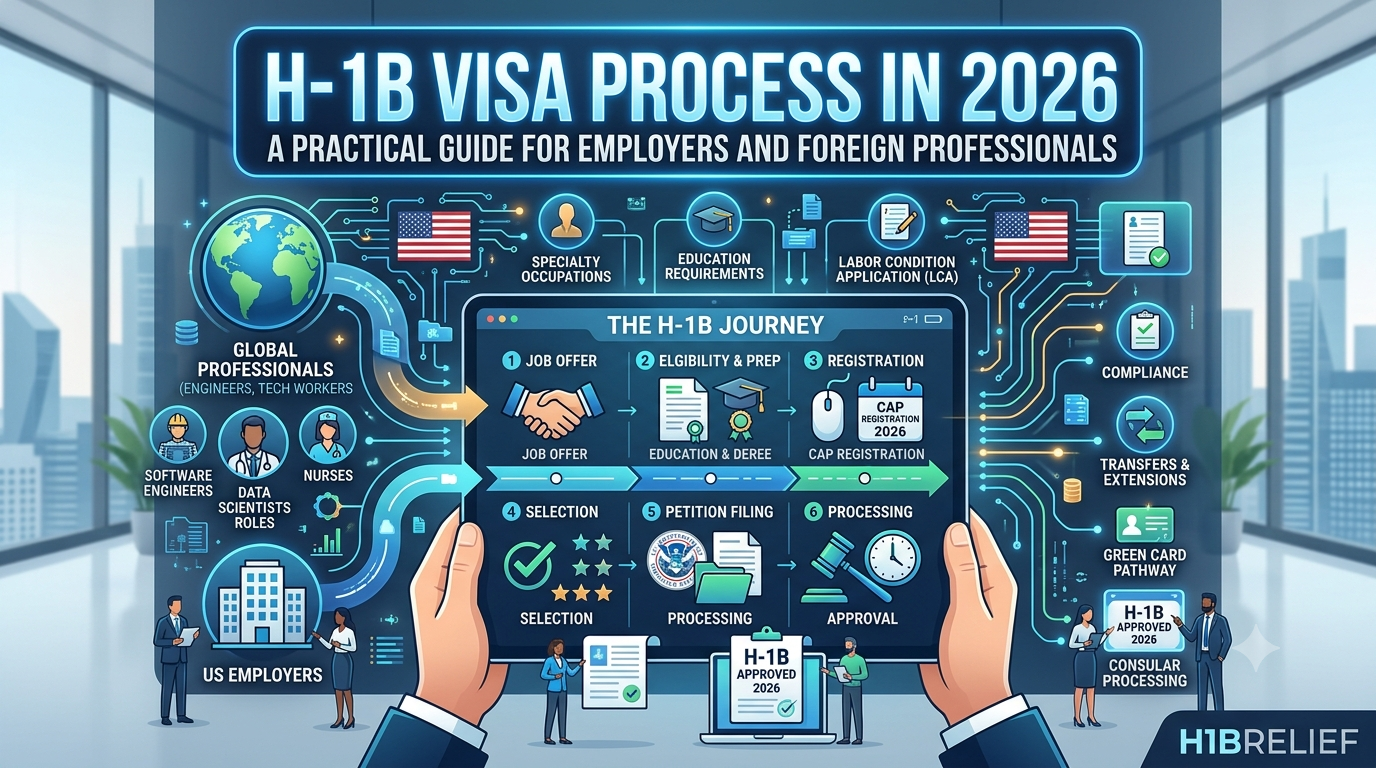
The H-1B visa remains an important U.S. immigration pathway for employers seeking to hire foreign professionals for specialty occupations. Technology companies, engineering firms, healthcare organizations, financial businesses, research institutions, and other U.S. employers may use the H-1B program when a position and candidate meet the applicable requirements.
For professionals and employers planning an H-1B application in 2026, understanding the process, eligibility requirements, registration process, documentation, and compliance responsibilities is essential.
Because U.S. immigration rules and procedures can change, applicants should always verify current requirements with official U.S. government sources or a qualified immigration professional.
What Is the H-1B Visa?
The H-1B is a temporary U.S. work visa for eligible foreign workers employed in qualifying specialty occupations.
A specialty occupation generally requires the theoretical and practical application of highly specialized knowledge and normally requires at least a bachelor’s degree or its equivalent in a directly related field, subject to the applicable rules.
Common H-1B occupations include:
- Software development
- Information technology
- Engineering
- Data science
- Financial analysis
- Architecture
- Scientific research
- Healthcare-related professional roles
- Business and technical specialties
The employer generally plays a central role in the H-1B petition process.
H-1B Visa Process in 2026
The H-1B process can involve several stages.
1. Determine H-1B Eligibility
The employer and prospective employee should first determine whether the position and candidate satisfy the requirements for H-1B classification.
Important considerations can include:
- Nature of the job
- Specialty occupation requirements
- Educational qualifications
- Relevant degree or equivalent
- Employer-employee relationship
- Work location
- Compensation
- Immigration status, where applicable
2. H-1B Registration
For cases subject to the annual H-1B cap, employers generally begin with the electronic registration process during the designated registration period.
USCIS uses the registration system to manage the selection process for cap-subject H-1B petitions.
Applicants should monitor the official USCIS announcements for registration dates, fees, and procedural changes for the applicable fiscal year.
3. Selection
If a registration is selected, the prospective employer may generally proceed with filing the H-1B petition during the applicable filing period.
Selection of a registration does not itself mean that the H-1B petition has been approved.
The employer still needs to submit the required petition and supporting documentation.
4. Labor Condition Application
The employer generally needs a certified Labor Condition Application (LCA) from the U.S. Department of Labor before filing the H-1B petition with USCIS.
The LCA process includes important employer attestations concerning wages and working conditions.
5. H-1B Petition Filing
The employer files the appropriate H-1B petition with USCIS along with the required documentation and applicable government fees.
Supporting documentation can include evidence related to:
- The employer
- The offered position
- Specialty occupation requirements
- Beneficiary qualifications
- Educational credentials
- Work location
- Compensation
- LCA
- Other applicable immigration information
6. USCIS Processing
USCIS reviews the petition and may:
- Approve the petition
- Issue a Request for Evidence (RFE)
- Deny the petition
An RFE does not automatically mean a petition will be denied. It means USCIS is requesting additional information or evidence before making a final decision.
H-1B Cap and Cap-Exempt Employers
Not every H-1B case is subject to the annual numerical cap.
Certain employers and organizations may qualify for cap-exempt H-1B classification, depending on their organization and the nature of the employment.
Examples can include certain:
- Institutions of higher education
- Nonprofit entities related to institutions of higher education
- Nonprofit research organizations
- Governmental research organizations
Whether a particular employer qualifies as cap-exempt depends on the applicable statutory and regulatory requirements.
H-1B Transfer
An H-1B worker may be able to change employers through an H-1B portability process when the applicable requirements are met.
An H-1B transfer is different from the initial cap-subject registration process.
The new employer generally needs to file an H-1B petition on behalf of the worker.
Because portability rules can involve timing and status considerations, workers should obtain appropriate immigration advice before changing employment.
H-1B Extension
An H-1B worker may generally receive extensions within the applicable maximum period when the legal requirements are satisfied.
In some circumstances, additional H-1B time may be available under provisions connected with employment-based permanent residence processes.
The exact eligibility depends on the individual’s immigration history and circumstances.
H-1B Change of Status vs. Consular Processing
H-1B cases can involve different processing paths.
Change of Status
A person already in the United States in an eligible nonimmigrant status may, when the requirements are met, request a change of status to H-1B.
Consular Processing
A person outside the United States may generally need to complete visa processing through a U.S. consulate or embassy before seeking admission in H-1B status.
These processes are different, and applicants should understand which pathway applies to their circumstances.
Documents Commonly Needed for an H-1B Case
The exact documentation varies by case, but an H-1B petition can involve documents such as:
- Passport information
- Educational certificates
- Degree transcripts
- Resume or CV
- Employment information
- Job description
- Employer documentation
- LCA documentation
- Previous immigration records
- Current U.S. status documents, where applicable
- Prior H-1B approval notices, where applicable
Employers and applicants should make sure documents are accurate and consistent across the petition.
Common H-1B Challenges
H-1B cases can become complicated when the evidence does not clearly establish eligibility.
Some areas that may require careful attention include:
Specialty Occupation Evidence
The job duties and requirements should support the applicable specialty-occupation criteria.
Education and Degree Matching
The beneficiary’s educational background should be relevant to the position and satisfy applicable requirements.
Work Location
Changes in work location can affect immigration and labor-condition obligations.
Employer Documentation
The petition should clearly establish the employer’s business, the offered position, and the underlying employment arrangement.
Maintaining Status
For workers already in the United States, maintaining lawful immigration status is an important consideration.
H-1B Compliance for Employers
H-1B sponsorship comes with employer responsibilities.
Employers may need to maintain appropriate records and comply with requirements involving:
- Wages
- Working conditions
- Public access documentation
- Employment terms
- Worksite requirements
- Immigration documentation
Companies should establish internal processes for monitoring immigration-related compliance.
H-1B and Green Card Process
Many H-1B professionals eventually explore employment-based permanent residence.
The green card process is separate from the H-1B process and can involve stages such as:
PERM Labor Certification → I-140 Immigrant Petition → Visa Availability → Adjustment of Status or Consular Processing
Not every case follows the same pathway, and visa-number availability can affect the timing.
An H-1B worker should understand that an H-1B approval does not automatically result in permanent residence.
H-1B for Technology Professionals
The technology industry continues to be an important area for H-1B employment.
Potential technology-related positions can include:
- Software engineers
- Full-stack developers
- Cloud engineers
- Data engineers
- Data scientists
- Cybersecurity professionals
- AI and machine-learning specialists
- Database professionals
- Systems analysts
However, job titles alone do not establish H-1B eligibility. The actual position requirements, duties, qualifications, and applicable legal criteria are important.
H-1B Planning in 2026
Professionals and employers can prepare by organizing documentation early and monitoring official announcements.
A practical preparation checklist includes:
For employers:
- Review the position requirements
- Confirm candidate qualifications
- Prepare accurate job descriptions
- Review wage requirements
- Plan the LCA process
- Monitor USCIS registration announcements
- Maintain required immigration records
For professionals:
- Keep educational records organized
- Maintain copies of immigration documents
- Review employment history
- Check current immigration status
- Keep passport information current
- Discuss case-specific questions with an immigration professional
Why Professional H-1B Guidance Matters
H-1B immigration cases can involve detailed legal and procedural requirements.
Professional guidance can be particularly useful when dealing with:
- H-1B transfers
- RFEs
- Status changes
- Extensions
- Employer changes
- Worksite changes
- Complicated education histories
- H-1B-to-green-card planning
Each case can have different facts, so information that applies to one applicant may not apply to another.
Conclusion
The H-1B visa process in 2026 involves multiple stages, from determining eligibility and completing registration, where applicable, to LCA processing, petition filing, and USCIS adjudication.
For employers, careful documentation and compliance are essential. For foreign professionals, understanding eligibility, maintaining immigration status, and preparing accurate documentation can help them navigate the process more effectively.
Because H-1B rules, fees, procedures, and government guidance can change, applicants should verify current information through official U.S. government sources and seek qualified immigration advice for individual circumstances.
H1BRelief can provide informational resources to help employers and foreign professionals better understand the H-1B process, immigration terminology, and important planning considerations.
Comments