The H-1B process has many important words:
Petition.
LCA.
USCIS.
Receipt notice.
Approval notice.
And one word that applicants seem to use approximately 47 times a day:
“Update?”
For many skilled professionals, the H-1B process can feel like a combination of career planning, paperwork management, email refreshing, and learning an entirely new dictionary.
So, while immigration matters should always be taken seriously, there are plenty of everyday moments that are surprisingly relatable.
Here are 10 of them.
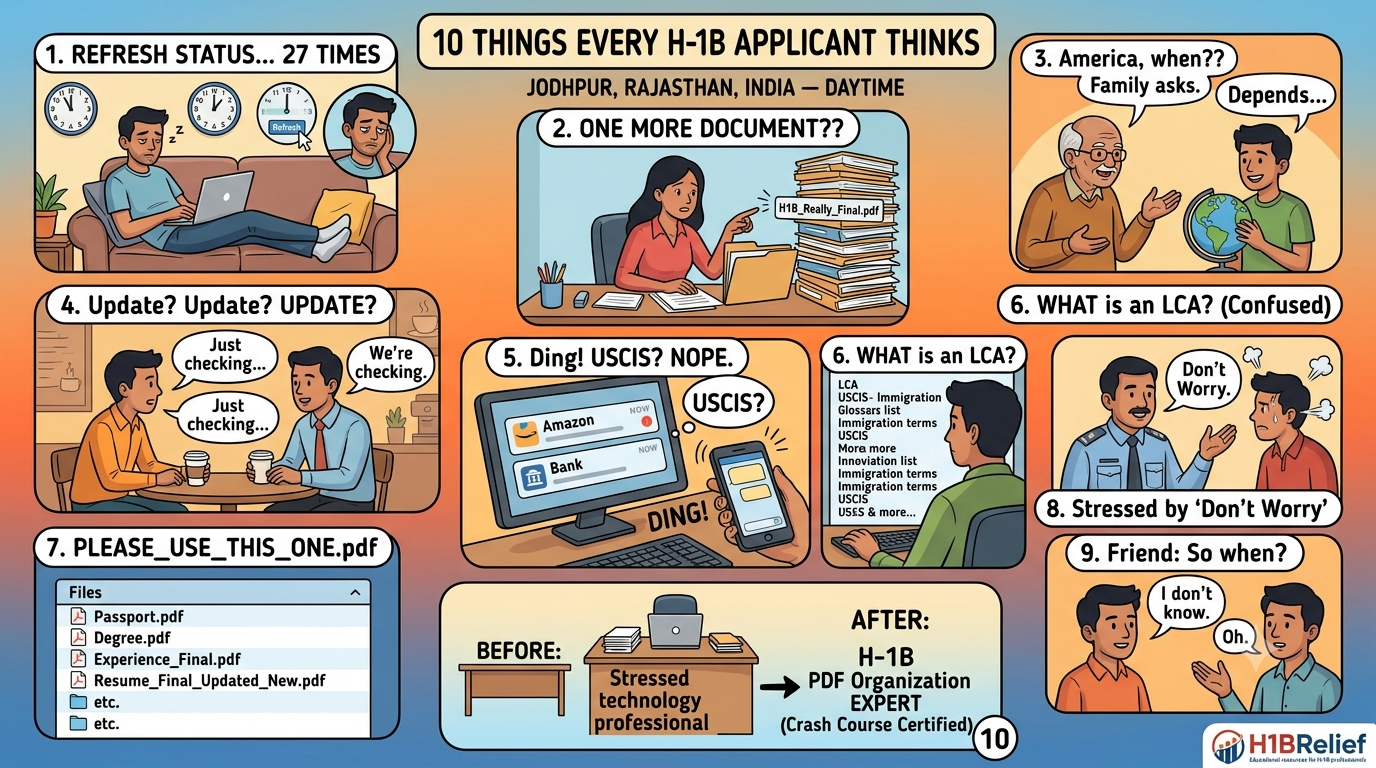
1. “I’ll Just Check the Status Once”
Applicant:
“I’ll check my case status once.”
Checks.
Nothing new.
Five minutes later:
Refresh.
Still nothing.
Another ten minutes:
Refresh.
Still nothing.
At this point, the browser has become part of the immigration strategy.
2. The Document Checklist
Someone says:
“We just need a few documents.”
Applicant opens the checklist.
Passport.
Degree certificate.
Transcripts.
Resume.
Employment information.
Previous immigration documents.
Photographs.
Letters.
Additional supporting documents.
Applicant:
“A few?”
The folder on the computer:
H1B_Final_Final_Updated_Really_Final.pdf
3. The Famous “One More Document”
Applicant:
“Everything is submitted.”
Then comes the email:
“We need one additional document.”
Applicant:
“Okay.”
Document submitted.
Then:
“We need one more clarification.”
Applicant:
“Okay…”
At this point, the applicant has become extremely familiar with their scanner.
4. Explaining H-1B to Family
Family member:
“So when are you going to America?”
Applicant:
“The immigration process is still ongoing.”
Family member:
“When will it finish?”
Applicant:
“It depends.”
Family member:
“What does depends mean?”
Applicant:
“It means… depends.”
Family member:
“So when are you going?”
Applicant:
“Let’s have dinner.”
5. The Employer Conversation
Employee:
“Any update on my H-1B?”
Employer:
“We’re checking.”
Employee:
“Great.”
Three days later:
“Any update?”
Employer:
“We’re still checking.”
Employee:
“Great.”
Another week later:
“Just checking…”
At this point, the phrase “just checking” has become a full-time job.
6. Immigration Vocabulary Suddenly Becomes Important
Before starting the process:
“What is an LCA?”
Later:
“What’s the difference between an LCA and an H-1B petition?”
Later:
“What does this notice mean?”
Later:
“Can someone explain this in simple English?”
Congratulations.
You started the process as a technology professional and accidentally completed a crash course in immigration terminology.
7. The PDF File Names
Every applicant eventually creates a collection of files like:
Passport.pdf
Degree.pdf
Resume.pdf
Experience.pdf
Experience_Final.pdf
Experience_Final_2.pdf
Experience_Final_Updated.pdf
Experience_Final_Updated_New.pdf
And finally:
PLEASE_USE_THIS_ONE.pdf
8. When Someone Says “Don’t Worry”
There are certain sentences that immediately increase your stress level.
“Don’t worry.”
“It’s probably fine.”
“We’ll see.”
“We are waiting for an update.”
The applicant smiles politely.
Then opens their email again.
9. The Email Notification
Phone:
Ding!
Applicant:
“USCIS?”
No.
Shopping notification.
Another ding.
“USCIS?”
No.
Bank notification.
Another ding.
“USCIS??”
Food delivery.
At this point, the applicant has developed a highly advanced skill:
Identifying email senders from notification sounds.
10. The Most Powerful H-1B Question
After explaining the entire immigration process to a friend for 30 minutes:
Friend:
“So… when will you know?”
Applicant:
“I don’t know.”
Friend:
“Oh.”
Applicant:
“Exactly.”
H-1B Is Serious—But the Process Can Still Have Funny Moments
The H-1B process involves important legal and immigration requirements, so applicants should rely on accurate information and qualified professional guidance for decisions specific to their circumstances.
But there is nothing wrong with laughing at the everyday experience:
Refreshing the case status.
Renaming documents.
Searching your inbox.
Asking for updates.
Explaining immigration terminology to family.
And wondering whether “one more document” really means one more document.
For professionals navigating the H-1B process, preparation and organized documentation can make the journey easier to manage.
And remember:
If you refresh the case-status page 27 times, the status usually doesn’t change faster.
We checked.
Probably.
Final Thought
The H-1B journey may involve paperwork, timelines, documentation, employer coordination, and plenty of waiting.
But one thing is almost guaranteed:
You’ll become very good at organizing PDFs.
And that’s a transferable skill.
H1BRelief provides educational information and resources to help H-1B professionals better understand the immigration process. For case-specific legal advice, consult a qualified U.S. immigration attorney.
Comments