For foreign professionals looking to work in the United States, finding an employer willing to sponsor an H-1B visa can be an important step toward building a U.S. career.
For employers, H-1B sponsorship involves more than offering a job. The employer must follow applicable immigration, wage, Labor Condition Application (LCA), documentation, and filing requirements.
In 2026, employers and foreign workers should also pay close attention to changing government procedures, wage information, filing requirements, and USCIS updates.
This guide explains H-1B visa sponsorship in 2026, including eligibility, employer requirements, registration, LCA, prevailing wages, petition filing, transfers, extensions, and common mistakes.
What Is H-1B Visa Sponsorship?
H-1B sponsorship occurs when a qualifying U.S. employer petitions for a foreign worker to perform qualifying work in the United States.
The H-1B classification is primarily used for specialty occupations, where the position and worker meet the applicable requirements.
Common H-1B occupations include:
- Software developers
- IT professionals
- Engineers
- Data scientists
- Financial analysts
- Architects
- Accountants
- Researchers
- Healthcare professionals
- Business and technology specialists
The employer generally plays a central role in the H-1B process because the petition is connected to the offered employment.
Who Can Sponsor an H-1B Worker?
A qualifying U.S. employer can generally file an H-1B petition for an eligible foreign worker.
USCIS describes a prospective H-1B petitioner as a U.S. employer or agent meeting the applicable requirements. For cap-subject registration, the employer must have a bona fide job offer and meet applicable registration requirements.
Potential H-1B sponsors can include:
- Technology companies
- Consulting companies
- Financial institutions
- Engineering companies
- Healthcare organizations
- Universities
- Research organizations
- Startups
- Other qualifying U.S. employers
Whether an employer can sponsor a particular worker depends on the facts of the position, employer, and immigration case.
H-1B Sponsorship Process in 2026
A typical cap-subject H-1B process can be summarized as:
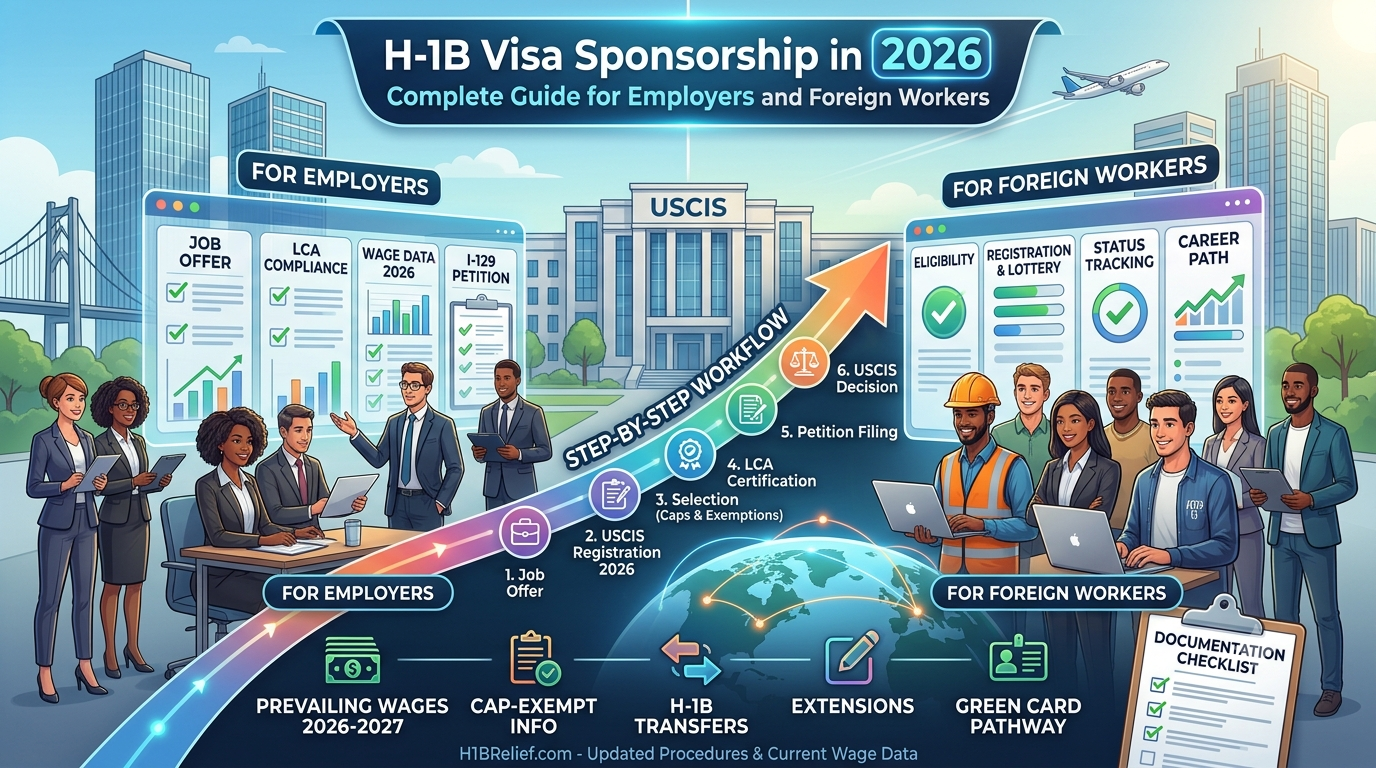
Job Offer → H-1B Registration → Selection, if applicable → LCA → Form I-129 → USCIS Decision → H-1B Employment
Not every H-1B case follows this exact sequence.
For example, certain cases may be exempt from the annual numerical cap.
Step 1: Find a Qualifying Job
The first step is generally finding a U.S. employer offering a position that may qualify for H-1B classification.
The position should have clearly defined:
- Job duties
- Required qualifications
- Work location
- Salary
- Employment terms
Step 2: Determine H-1B Eligibility
The employer and worker should evaluate whether the position and beneficiary satisfy the applicable requirements.
The job generally needs to qualify as a specialty occupation, while the worker must have the required educational or equivalent qualifications.
Step 3: H-1B Registration
For cases subject to the annual numerical allocation, the prospective petitioner generally needs to complete the USCIS electronic registration process during the applicable registration period.
USCIS states that a prospective petitioner generally may submit only one registration per beneficiary in a fiscal year.
Registration is not the same as filing the complete H-1B petition.
Step 4: Selection
If USCIS receives enough registrations to reach the applicable numerical allocation, USCIS conducts the selection process described in its H-1B registration procedures.
A selected registration allows the petitioner to proceed with an eligible cap-subject H-1B petition.
Step 5: Labor Condition Application
The employer generally needs an approved LCA for the H-1B employment.
The LCA process is administered by the U.S. Department of Labor.
The LCA includes important information regarding the employment, including the:
- Occupation
- Wage
- Work location
- Employment conditions
H-1B Prevailing Wage Requirements
Wages are an important part of H-1B sponsorship.
The Department of Labor states that an H-1B employer generally must pay the higher of the actual wage or prevailing wage, subject to applicable requirements.
The actual wage refers to the wage the employer pays workers with similar experience and qualifications performing the same job.
The prevailing wage is associated with similarly employed workers in the relevant occupational classification and geographic area.
Employers should therefore evaluate:
- Job title
- Occupational classification
- Skill level
- Work location
- Employee qualifications
- Actual wage
- Prevailing wage
H-1B Wage Data for 2026
The Department of Labor published updated prevailing wage data for the July 2026 through June 2027 wage year. The updated data became effective July 1, 2026.
This means employers preparing H-1B cases during this period should use the applicable current wage information rather than relying on outdated wage data.
H-1B Petition Filing
After the applicable registration and selection process, the employer can proceed with the H-1B petition when eligible.
The petition generally uses Form I-129, Petition for a Nonimmigrant Worker, together with supporting evidence.
Documentation can include:
- Employer information
- Job offer
- Job description
- Beneficiary resume
- Degree certificates
- Transcripts
- Passport information
- Current immigration documents
- LCA
- Evidence supporting the specialty occupation
- Other case-specific documentation
The required evidence depends on the individual case.
H-1B Employer Responsibilities
H-1B sponsorship creates important responsibilities for employers.
Employers must comply with applicable requirements concerning:
- Wages
- Working conditions
- Employment terms
- LCA requirements
- Required notices
- Recordkeeping
- Immigration filings
The Department of Labor states that H-1B workers generally must receive the required wage and comparable working conditions and benefits under the applicable rules.
Employers also cannot improperly shift certain employer-related costs to H-1B workers.
H-1B Worker Rights
H-1B workers have protections under U.S. labor laws.
According to the Department of Labor, an H-1B worker must generally receive the applicable actual or prevailing wage, whichever is higher. Employers also have restrictions concerning certain deductions, petition-related costs, and working conditions.
Workers should keep copies of important documents, including:
- H-1B approval notice
- Passport
- I-94
- Visa
- Pay records
- Employment documentation
- LCA information
Keeping organized records can be useful when changing employers, extending status, or addressing employment-related questions.
H-1B Transfer to a New Employer
An H-1B worker may be eligible to change employers through a new H-1B petition.
This is commonly called an H-1B transfer.
The new employer generally needs to file the appropriate petition and satisfy the applicable requirements.
Workers should not assume that every job change is automatically permitted. The timing and circumstances of the new petition can matter.
H-1B Extension
An H-1B worker who remains eligible may seek an extension of H-1B status.
Employers should monitor the employee’s:
- H-1B expiration date
- I-94 expiration date
- Passport validity
- Employment authorization
- Petition filing deadlines
Starting the extension process early can help employers and workers manage documentation and filing requirements.
H-1B Cap-Exempt Employers
Not all H-1B employment is subject to the same annual cap.
Certain organizations may qualify for cap-exempt treatment under the applicable rules.
Potential examples include certain:
- Institutions of higher education
- Nonprofit organizations affiliated with institutions of higher education
- Nonprofit research organizations
- Government research organizations
The specific organizational structure and employment circumstances must be evaluated before determining whether an H-1B case qualifies for an exemption.
H-1B Processing Times
H-1B processing times can vary depending on the petition type, service option, workload, and other factors.
USCIS maintains an online processing-time tool where applicants can select the applicable form, category, and processing location to obtain current processing information.
Applicants should avoid relying on old processing-time estimates when planning an immigration filing.
H-1B Premium Processing
Some eligible H-1B petitions may qualify for premium processing.
Premium processing provides an expedited USCIS adjudication process for eligible filings subject to the applicable rules and fee.
However, premium processing should not be confused with guaranteed approval.
The current USCIS requirements, fee, and processing timeframe should be checked before filing.
Common H-1B Sponsorship Mistakes
Employers and workers can encounter problems when the petition documentation does not clearly match the actual employment.
1. Unclear Job Description
The job description should accurately explain the position and its responsibilities.
2. Wage Problems
Employers need to correctly evaluate the applicable wage requirements.
3. Incorrect Work Location
The work location can affect LCA and wage considerations.
4. Inconsistent Documents
The petition, LCA, job description, employee resume, and supporting documents should be consistent with the actual employment situation.
5. Missing Evidence
Insufficient documentation can result in additional questions or requests for evidence.
6. Waiting Until the Last Minute
Employers should monitor registration periods, petition deadlines, and existing H-1B expiration dates.
H-1B Sponsorship for Technology Workers
Technology remains an important area for H-1B employment.
Potential positions can include:
- Software Engineer
- Full Stack Developer
- Cloud Engineer
- Data Scientist
- Machine Learning Engineer
- DevOps Engineer
- Cybersecurity Engineer
- Database Administrator
- Solutions Architect
- Business Systems Analyst
However, the job title alone does not establish H-1B eligibility.
The actual duties, requirements, employer circumstances, and beneficiary qualifications are important.
H-1B Sponsorship and Green Card
H-1B status and employment-based permanent residence are separate immigration processes.
An H-1B worker may potentially pursue an employment-based green card while maintaining H-1B status, if eligible.
A common employment-based pathway can involve:
PERM → I-140 → Adjustment of Status or Consular Processing
The exact process depends on the employment-based category and individual circumstances.
How to Find an H-1B Sponsor
Foreign professionals searching for H-1B sponsorship can research employers based on:
- Industry
- Job requirements
- Location
- Previous sponsorship activity
- Available positions
- Company size
- Role requirements
Candidates should also be careful when evaluating job advertisements that promise guaranteed H-1B sponsorship.
A legitimate employer should be able to explain its hiring and immigration process clearly.
How H1BRelief Can Help
H-1B immigration involves multiple stages, and information can change as government agencies update their procedures.
H1BRelief provides educational information about:
- H-1B visa requirements
- H-1B sponsorship
- H-1B registration
- H-1B transfers
- H-1B extensions
- LCA requirements
- Prevailing wages
- H-1B RFEs
- Employment-based immigration
- Green card pathways
- U.S. immigration updates
For individual legal advice or case-specific immigration strategy, applicants should consult a qualified U.S. immigration attorney.
H-1B Sponsorship in 2026: Key Takeaways
The H-1B sponsorship process requires coordination between the employer, foreign worker, U.S. Citizenship and Immigration Services, and the Department of Labor.
The most important areas to understand include:
- Specialty occupation requirements
- Worker qualifications
- H-1B registration
- Cap and cap-exempt cases
- LCA requirements
- Prevailing and actual wage requirements
- Petition documentation
- Employer responsibilities
- H-1B transfers
- H-1B extensions
- Current USCIS procedures
The Department of Labor’s current 2026 information confirms that updated prevailing wage data applies from July 1, 2026 through June 30, 2027.
Because immigration rules and agency procedures can change, employers and foreign workers should verify current requirements before taking action.
Frequently Asked Questions
What is H-1B sponsorship?
H-1B sponsorship is the process through which a qualifying U.S. employer petitions for an eligible foreign worker to work in a qualifying H-1B position.
Who can sponsor an H-1B employee?
A qualifying U.S. employer can generally sponsor an eligible foreign worker. Certain organizations may also qualify for H-1B cap exemptions.
Does every H-1B case require registration?
Registration generally applies to cap-subject H-1B cases. Some cases can be exempt from the annual numerical allocation.
What is an H-1B LCA?
An LCA is a Labor Condition Application submitted to the Department of Labor for H-1B employment. It contains information about the offered employment and wage.
How is the H-1B wage determined?
The employer generally must pay the higher of the applicable actual wage or prevailing wage, subject to the relevant H-1B requirements.
Can an H-1B worker change employers?
An eligible H-1B worker may potentially change employers through the applicable H-1B petition process.
Can an H-1B worker apply for a green card?
An H-1B worker may pursue an employment-based green card if eligible. The green card process is separate from H-1B status.
How long does H-1B processing take?
Processing times vary. USCIS provides current processing-time information through its online processing-time tool.
Conclusion
H-1B visa sponsorship in 2026 requires careful planning by both employers and foreign professionals.
From determining whether a position qualifies as a specialty occupation to completing registration, meeting LCA requirements, documenting wages, filing the petition, and maintaining H-1B status, each stage requires accurate information and documentation.
H1BRelief helps employers and foreign professionals understand the H-1B process through practical immigration resources and current information.
For case-specific questions, always verify the latest USCIS and Department of Labor requirements and consider consulting a qualified immigration attorney.
Comments