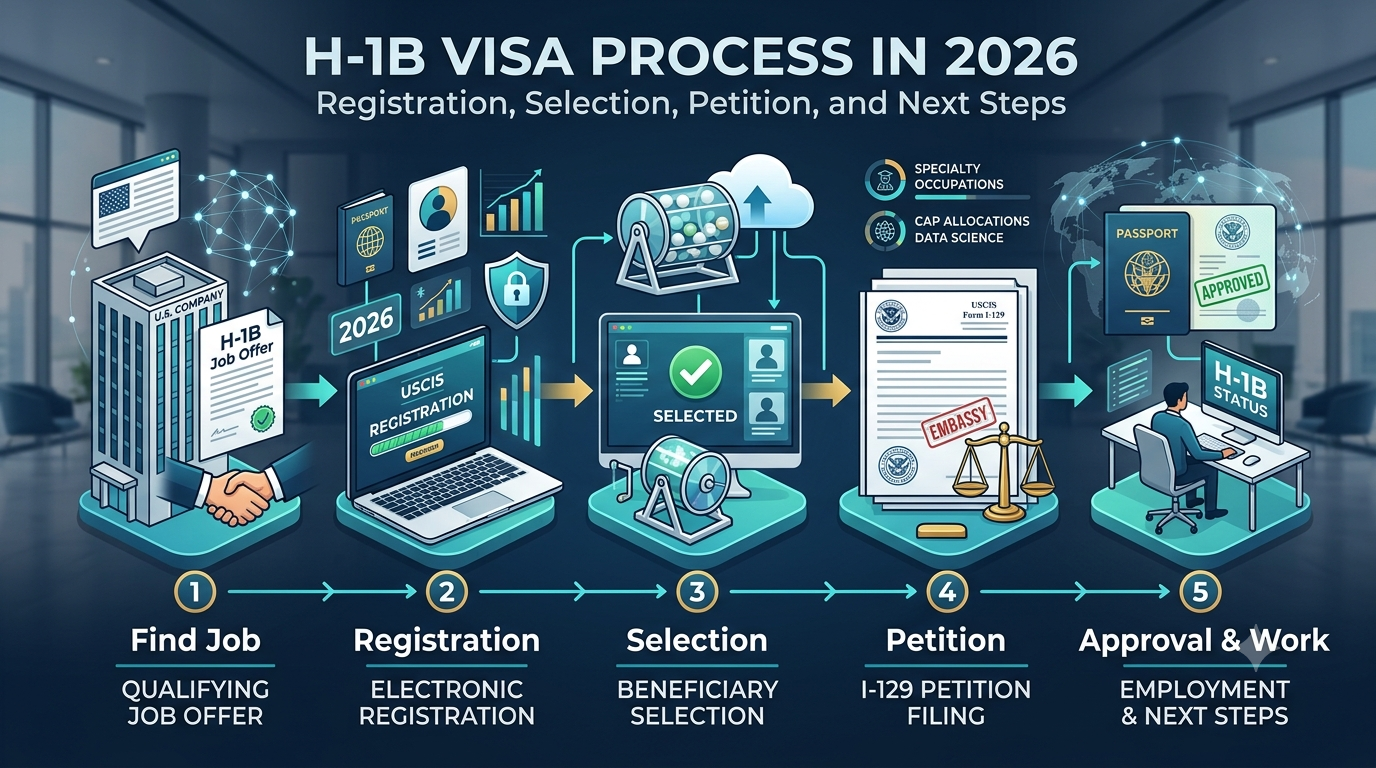
The H-1B visa remains one of the most important U.S. immigration pathways for foreign professionals seeking employment in specialty occupations.
However, the H-1B process involves multiple stages. For cap-subject cases, employers generally begin with electronic registration, followed by selection and petition filing if the registration is selected.
For anyone preparing for the H-1B visa process in 2026, understanding the sequence of steps, required information, employer responsibilities, and potential issues can make the process easier to navigate.
This guide explains the major stages of the H-1B process and what applicants and employers should understand before moving forward.
Important: Immigration rules and procedures can change. The information below is general educational information and should be checked against current USCIS guidance or discussed with a qualified immigration attorney for an individual case.
What Is an H-1B Visa?
The H-1B classification allows U.S. employers to employ foreign workers in qualifying specialty occupations.
Typical H-1B positions may include roles in:
- Software development
- Information technology
- Engineering
- Data science
- Finance
- Architecture
- Healthcare
- Research
- Business analysis
- Other specialized professional fields
The employer generally serves as the petitioner, meaning the H-1B process is connected to a specific U.S. employment opportunity.
How Does the H-1B Process Work?
For a typical cap-subject H-1B case, the process can be summarized as:
Employer identifies candidate
↓
H-1B electronic registration
↓
USCIS selection process
↓
Employer files Form I-129 if selected
↓
USCIS adjudication
↓
Visa processing, if applicable
↓
Employment in H-1B status
The exact process can differ depending on the applicant’s current immigration status, employment situation, degree, and whether the position is subject to the annual cap.
Step 1: Find a Qualifying H-1B Job
The process generally begins with a U.S. employer offering a qualifying position.
The position should meet the requirements for a specialty occupation, and the employer must be able to satisfy the applicable petition requirements.
Common examples include:
- Software Engineer
- Software Developer
- Data Scientist
- Systems Analyst
- Civil Engineer
- Electrical Engineer
- Financial Analyst
- Research Scientist
The job title alone does not determine H-1B eligibility. The position and its requirements must be evaluated under the applicable immigration rules.
Step 2: H-1B Electronic Registration
For cap-subject H-1B cases, prospective petitioners submit electronic registrations during the designated USCIS registration period.
USCIS requires information about the prospective beneficiary and petitioner as part of the registration process.
USCIS guidance states that a prospective petitioner generally may submit only one registration per beneficiary in a fiscal year. The registration system also uses beneficiary information, including valid passport or travel-document information, under the current registration framework.
The registration stage is important because an employer generally needs a selected registration before proceeding with a cap-subject H-1B petition.
Step 3: H-1B Registration Selection
If USCIS receives enough registrations to reach the applicable numerical allocations, USCIS conducts the selection process.
The current beneficiary-centric system selects unique beneficiaries rather than giving an individual multiple chances simply because multiple employers submitted registrations on that person’s behalf.
Selection, however, is not the same as H-1B approval.
A selected registration allows the petitioner to proceed with the applicable H-1B petition filing process.
Step 4: Prepare the H-1B Petition
After selection, the employer can prepare the H-1B petition.
The petition package may involve documentation related to:
- Employer information
- Job position
- Employee qualifications
- Educational background
- Offered salary
- Work location
- Specialty occupation
- Supporting documentation
- Applicable forms and fees
The documentation requirements depend on the circumstances of the case.
Accuracy is especially important because USCIS has authority to take action when registration information is inaccurate, fraudulent, or materially misrepresented.
Step 5: File Form I-129
The employer generally files Form I-129, Petition for a Nonimmigrant Worker, when seeking H-1B classification for the worker.
The petition must be filed according to the applicable USCIS instructions and within the relevant filing period.
USCIS provides case-status and processing-time tools for tracking applications and petitions after filing.
Step 6: USCIS Reviews the Petition
After receiving the petition, USCIS reviews the filing.
Depending on the case, USCIS may:
- Approve the petition
- Request additional evidence
- Issue another type of notice
- Deny the petition
A Request for Evidence (RFE) does not automatically mean that a petition will be denied. It means USCIS is requesting additional information or evidence before making a decision.
The employer and immigration counsel should carefully review the request and respond within the required timeframe.
Step 7: Visa Processing for Applicants Outside the United States
If the beneficiary is outside the United States and the case requires visa issuance, an approved petition may be followed by the appropriate visa application and consular process.
This is different from the petition approval itself.
In other words:
H-1B Petition Approval ≠ Automatically Receiving an H-1B Visa Stamp
The appropriate next step depends on the beneficiary’s location, immigration history, and circumstances.
Step 8: H-1B Employment
Once the necessary immigration steps have been completed, the worker may begin employment according to the terms authorized under the H-1B classification.
Employers should ensure that employment information remains consistent with applicable immigration requirements.
Changes involving employment, location, employer, or job circumstances may require additional immigration analysis.
H-1B Documents Applicants Commonly Prepare
Depending on the case, an applicant may need documents such as:
- Passport
- Academic degrees
- Academic transcripts
- Resume/CV
- Experience letters
- Employment records
- Professional credentials
- Current immigration documents, if applicable
- Previous approval notices, if applicable
The exact documents required can vary significantly from one case to another.
H-1B Employer Documentation
The employer may need to provide information relating to:
- Company identity
- Business operations
- Job position
- Job duties
- Work location
- Salary
- Organizational structure
- Employee requirements
- Supporting company documentation
The objective is to establish the relevant facts supporting the petition.
H-1B Registration Errors to Avoid
Small mistakes during the registration process can create significant problems.
Applicants and employers should carefully verify:
Passport Information
USCIS requires beneficiary information as part of the registration process, including valid passport or travel-document information under the current system.
Duplicate Registrations
USCIS guidance states that a registrant may generally submit only one registration per beneficiary in a fiscal year. Multiple registrations by the same registrant for the same beneficiary can result in invalidation.
Employer Information
The petitioning company’s information should be reviewed carefully before submission.
Educational Information
Degree and qualification information should accurately reflect the beneficiary’s documentation.
Job Information
The job title, duties, location, and other employment details should be consistent throughout the filing.
H-1B Cap and Advanced Degree Exemption
The H-1B program includes annual numerical limitations for certain cap-subject cases.
There is also an exemption associated with qualifying U.S. master’s or higher degrees.
Eligibility for the advanced-degree exemption depends on the applicable statutory and regulatory requirements.
Applicants should not assume that having a master’s degree automatically guarantees selection or approval.
H-1B Regular Processing vs. Premium Processing
USCIS offers different processing options for eligible petitions.
Under premium processing, USCIS provides expedited adjudicative action for eligible cases in exchange for the applicable premium processing fee.
Premium processing does not guarantee petition approval.
It is also important to distinguish faster petition processing from other stages of the immigration process, such as visa appointment availability or consular processing.
H-1B Transfer
An H-1B worker may sometimes change employers through an H-1B petition filed by the new employer.
This is commonly referred to as an H-1B transfer, although technically it involves a new petition rather than simply transferring an existing visa.
The specific rules depend on the worker’s current status and circumstances.
H-1B Extension
An H-1B worker who qualifies for continued H-1B classification may be eligible for an extension.
The employer generally files the required petition before the current authorized period expires.
Applicants should monitor their expiration dates carefully and avoid waiting until the last moment to address an extension.
H-1B to Green Card Process
The H-1B classification is a temporary nonimmigrant classification, but some H-1B workers may pursue permanent residence through employment-based immigration.
A common employment-based pathway may involve:
PERM Labor Certification → I-140 → Adjustment of Status / Consular Processing
However, not every case follows the same process.
Eligibility, visa availability, employer sponsorship, country of chargeability, and other factors can affect the timeline.
Why Professional H-1B Guidance Matters
The H-1B process combines immigration rules, employer requirements, documentation, deadlines, and government procedures.
Professional guidance can be particularly useful when a case involves:
- Previous visa issues
- Status changes
- RFEs
- Employer changes
- Complex employment history
- Degree equivalency questions
- H-1B extensions
- H-1B transfers
- Immigration violations
- Employment-based green card planning
An immigration attorney can assess the specific facts of an individual’s case and provide legal advice where appropriate.
Frequently Asked Questions
Is H-1B registration the same as H-1B approval?
No. Registration and petition approval are separate stages. Selection of a registration allows the prospective petitioner to proceed with the applicable petition filing process; USCIS must still adjudicate the petition.
Can multiple employers register the same H-1B beneficiary?
Multiple prospective petitioners may potentially submit registrations for the same beneficiary, but the current beneficiary-centric selection system treats the individual as one unique beneficiary for selection purposes. Employers must also follow USCIS rules concerning legitimate filings and accurate information.
What happens after H-1B selection?
The selected petitioner can generally proceed with filing the applicable H-1B petition during the designated filing period.
Can an H-1B petition receive an RFE?
Yes. USCIS may request additional evidence when it determines that additional information is needed to adjudicate the petition.
Can H-1B workers change employers?
An H-1B worker may be able to move to another employer through an appropriate H-1B petition, subject to the applicable requirements.
Does H-1B approval automatically provide a visa stamp?
No. Petition approval and visa issuance are separate parts of the immigration process. The required steps depend on the applicant’s circumstances.
Conclusion
The H-1B visa process in 2026 involves several important stages, from finding a qualifying U.S. position and completing electronic registration to selection, petition filing, USCIS adjudication, and—when applicable—visa processing.
The most important principle is to treat every stage as a separate requirement.
Accurate information, timely filings, appropriate documentation, and careful attention to current USCIS requirements can help employers and applicants navigate the process more effectively.
For case-specific immigration advice, applicants should consult a qualified U.S. immigration attorney.
H1BRelief provides educational resources designed to help H-1B applicants and employers better understand the U.S. immigration process and prepare for important H-1B-related steps.
Comments