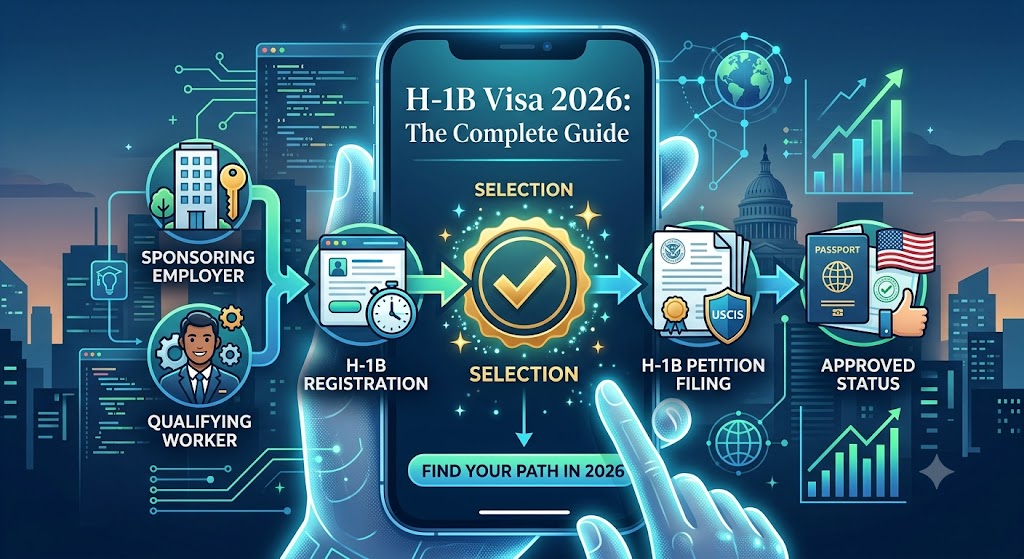
The H-1B visa remains one of the most important U.S. work visa options for skilled foreign professionals seeking employment with American companies.
Technology professionals, engineers, software developers, data scientists, analysts, architects, healthcare professionals, and other specialized workers may qualify for H-1B sponsorship when their job and qualifications meet the applicable requirements.
However, the H-1B process can be complex.
From finding a sponsoring employer and determining eligibility to H-1B registration, selection, petition filing, and maintaining status, each stage requires careful attention.
In 2026, employers and foreign professionals should approach the H-1B process with a clear understanding of the requirements and timelines.
This guide explains the major stages of the H-1B visa process in 2026 and what applicants and employers should know before moving forward.
What Is an H-1B Visa?
The H-1B is a temporary U.S. work visa for foreign professionals who will work in a specialty occupation.
A specialty occupation generally requires the application of specialized knowledge and a bachelor’s degree or higher in a directly related specialty, or an equivalent qualification under the applicable rules.
Common H-1B occupations include:
- Software developers
- Software engineers
- Data scientists
- IT professionals
- Systems analysts
- Financial analysts
- Engineers
- Architects
- Healthcare professionals
- Researchers
- Business and technology specialists
The H-1B program is primarily employer-sponsored. In most cases, the U.S. employer plays a central role in the petition process.
Who Can Qualify for an H-1B Visa?
H-1B eligibility depends on several factors, including the position, the worker’s qualifications, and the employer’s ability to meet the applicable requirements.
A prospective H-1B worker generally needs:
- A qualifying specialty-occupation position
- The required educational background or equivalent qualifications
- A U.S. employer willing to sponsor the worker
- A position that meets the applicable H-1B requirements
- An employer able to complete the required filing and compliance process
Having a bachelor’s degree alone does not automatically guarantee H-1B eligibility.
The job itself must also qualify.
For example, an employer and applicant should be able to establish why the position requires specialized knowledge and how the applicant’s education or experience relates to the position.
H-1B Sponsorship: Why the Employer Matters
Unlike some immigration categories, an H-1B worker generally cannot simply apply independently without an appropriate sponsoring employer.
The employer typically has important responsibilities throughout the process.
These can include:
- Identifying the appropriate position
- Determining the required wage
- Completing required labor-related filings
- Registering the prospective worker when registration is required
- Filing the H-1B petition after selection
- Providing supporting documentation
- Maintaining required records
- Meeting applicable H-1B compliance obligations
This makes choosing the right employer an important part of an H-1B strategy.
Understanding the H-1B Registration Process
For cap-subject H-1B cases, prospective petitioners generally must complete the electronic registration process during the designated registration period.
The registration process allows U.S. employers to identify prospective H-1B workers before filing a full petition for selected registrations.
A registration does not mean that an applicant has received an H-1B visa.
Instead, selection generally allows the sponsoring employer to proceed with the next stage of the petition process, subject to the applicable rules.
Applicants should therefore understand the difference between:
Registration → Selection → Petition Filing → Adjudication → Visa/Status Process
These are separate stages.
H-1B Selection Is Not the Same as H-1B Approval
One of the most common misunderstandings is believing that H-1B selection means the visa has already been approved.
It does not.
If a registration is selected, the employer generally receives an opportunity to file the corresponding H-1B petition during the applicable filing period.
USCIS then reviews the petition.
The petition must satisfy the applicable requirements before approval can be granted.
Therefore:
H-1B Registration ≠ H-1B Selection ≠ H-1B Approval
Understanding this distinction can help applicants avoid unrealistic expectations.
What Happens After H-1B Selection?
After selection, the sponsoring employer generally moves forward with the H-1B petition.
The petition package may include documentation relating to:
- Employer information
- Job duties
- Position requirements
- Employee qualifications
- Degree documentation
- Employment information
- Wage information
- Work location
- Required immigration forms
- Supporting evidence
The exact documentation depends on the circumstances of the case.
Strong documentation is important because the petition needs to demonstrate that the proposed employment and beneficiary satisfy the applicable H-1B requirements.
H-1B Visa vs. H-1B Status
The terms H-1B visa and H-1B status are often used interchangeably, but they are not exactly the same.
A visa is generally used for seeking admission to the United States.
H-1B status concerns the individual’s authorized immigration status while in the United States.
For someone already in the United States, an approved H-1B petition may involve a change or extension of status rather than obtaining a visa stamp immediately.
Applicants should understand which process applies to their individual situation.
H-1B Change of Status
A foreign professional who is already lawfully present in the United States may, depending on the circumstances, be eligible for a change of status to H-1B.
For example, an individual may currently hold another nonimmigrant status and have an employer
Comments