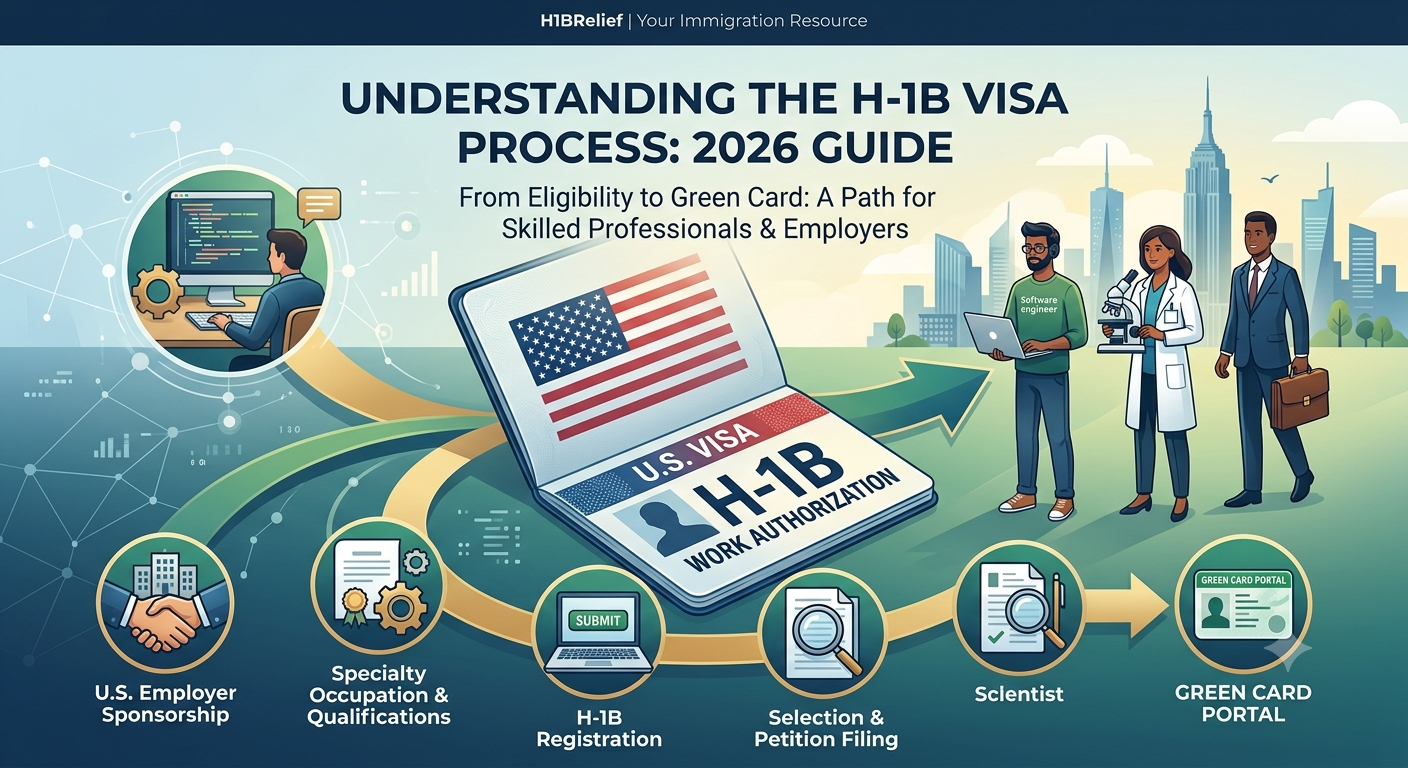
The U.S. continues to attract skilled professionals from around the world who want to build their careers in technology, engineering, healthcare, finance, research, and other specialized industries.
For many foreign professionals, the H-1B visa is one of the most important pathways to work legally in the United States. However, the H-1B process can be complicated. From understanding eligibility requirements and employer sponsorship to registration, selection, petition filing, and maintaining status, every stage requires careful attention.
Whether you are an international professional planning to work in the U.S. or an employer looking to hire specialized talent, understanding how the H-1B process works can help you make better decisions.
What Is an H-1B Visa?
The H-1B is a U.S. nonimmigrant work visa designed for foreign professionals who will work in a specialty occupation.
A specialty occupation generally requires specialized knowledge and a bachelor’s degree or higher in a specific field, or an equivalent qualification.
Common H-1B occupations include:
- Software engineering
- Information technology
- Data science
- Artificial intelligence
- Engineering
- Healthcare
- Finance
- Architecture
- Scientific research
- Business and management
- Cybersecurity
One of the most important aspects of the H-1B program is that the employer generally sponsors the worker. An individual cannot simply apply for an H-1B visa independently without an appropriate employer and qualifying job.
Who Can Qualify for an H-1B?
H-1B eligibility depends on several factors.
Typically, the applicant must have:
- A qualifying job offer from a U.S. employer
- A position that qualifies as a specialty occupation
- The required educational background or equivalent experience
- An employer willing and able to sponsor the H-1B petition
- A petition filed with the appropriate U.S. government agency
The relationship between the employee’s educational background and the job requirements is particularly important.
For example, a software development position may require a degree in computer science, software engineering, information technology, or a closely related field.
How Does the H-1B Process Work?
The H-1B process can involve several stages.
1. Find a Qualifying Employer
The process normally begins when a U.S. employer offers a qualifying position to a foreign professional.
The employer must be prepared to comply with H-1B requirements and file the necessary paperwork.
2. H-1B Registration
For cap-subject cases, prospective petitioners generally participate in the electronic registration process during the designated registration period.
Because the number of available H-1B visas is limited, registration and selection can be a major part of the process.
3. Selection
If the registration is selected, the employer may proceed with the next stage of the H-1B petition process.
Selection, however, does not automatically mean that an H-1B visa has been approved.
The employer still needs to prepare and file the required petition and supporting documentation.
4. Petition Filing
The sponsoring employer submits the H-1B petition and supporting evidence.
The documentation may include information about:
- The employer
- The offered position
- Salary
- Work location
- Employee qualifications
- Educational credentials
- Specialty occupation requirements
5. Government Review
The petition is reviewed by U.S. immigration authorities.
Depending on the circumstances, additional evidence may be requested.
6. Approval and Visa Processing
Once the petition is approved, the next steps depend on the worker’s circumstances.
Someone outside the United States may generally need to complete visa processing before entering the country in H-1B status, while someone already in the U.S. may have a different process.
H-1B Cap and Lottery
The H-1B program has an annual numerical limit for many new H-1B cases.
Because demand can exceed the available quota, the government uses an electronic registration and selection process for cap-subject cases.
This makes timing extremely important for both employers and prospective employees.
It is also important to remember that being selected in the H-1B registration process is not the same as receiving H-1B approval.
The subsequent petition must still satisfy the applicable requirements.
H-1B Transfer
One of the major advantages of H-1B status is that eligible H-1B workers may be able to change employers without going through the entire initial H-1B process again.
This is commonly referred to as an H-1B transfer.
The new employer generally needs to file the appropriate petition before the worker can begin working for the new employer under the applicable portability rules.
Because employment changes can have immigration consequences, workers should carefully review their situation before changing jobs.
H-1B Extension
H-1B status is generally granted for an initial period and can commonly be extended, subject to the applicable rules.
In many situations, H-1B status can be maintained for up to six years.
However, certain circumstances involving employment-based permanent residence may allow an individual to remain in H-1B status beyond the normal six-year limitation.
These cases can become complicated, particularly when green-card processing is already underway.
H-1B and Green Card
For many professionals, the H-1B is not the final destination.
Instead, it can be part of a longer-term immigration strategy that eventually leads to permanent residence.
An employer may sponsor an eligible employee for an employment-based green card.
The process can involve several stages, depending on the employment category and the individual’s circumstances.
Important factors can include:
- Employer sponsorship
- Labor certification requirements
- Immigrant petition
- Priority date
- Visa availability
- Adjustment of status or consular processing
Because employment-based immigration can take considerable time, planning early can be extremely valuable.
Common H-1B Challenges
H-1B applicants and employers frequently face challenges such as:
Specialty Occupation Issues
The position must meet the applicable specialty occupation requirements. A job title alone does not determine eligibility.
Education and Degree Matching
The applicant’s education should generally be relevant to the requirements of the offered position.
Employer Documentation
Incomplete or inconsistent documentation can create problems during petition processing.
Work Location Changes
Changes in employment location may have immigration implications and should be reviewed before implementation.
RFE
An RFE (Request for Evidence) may be issued when additional information or documentation is needed.
Receiving an RFE does not automatically mean the petition will be denied, but the response needs to address the government’s concerns carefully.
How H1BRelief Can Help
Navigating the U.S. immigration system can be challenging, especially when you are dealing with strict deadlines, employer requirements, documentation, and changing immigration policies.
H1BRelief can provide useful information and resources to help H-1B professionals and employers better understand important immigration topics.
From H-1B visa information and employer sponsorship to work authorization, visa processes, and immigration updates, having reliable information can make it easier to understand your options.
Why Staying Updated Matters in 2026
U.S. immigration rules, procedures, fees, filing requirements, and government policies can change.
Professionals should avoid relying solely on old blog posts, social media discussions, or information shared by friends.
Instead, verify important immigration information through official government resources and, when appropriate, consult a qualified U.S. immigration attorney.
Final Thoughts
The H-1B visa can provide an important opportunity for skilled professionals who want to work in the United States.
However, the process involves more than simply getting selected in an H-1B registration. Employer sponsorship, specialty occupation requirements, qualifications, documentation, petition filing, and immigration status all play important roles.
For professionals planning their U.S. careers, early preparation and accurate information can make a significant difference.
H1BRelief aims to make complex H-1B and U.S. immigration topics easier to understand by providing practical resources and timely information for professionals and employers.
Disclaimer: This article is for general informational purposes only and should not be considered legal advice. Immigration rules and procedures can change. For advice about a specific immigration situation, consult a qualified U.S. immigration attorney.
Comments